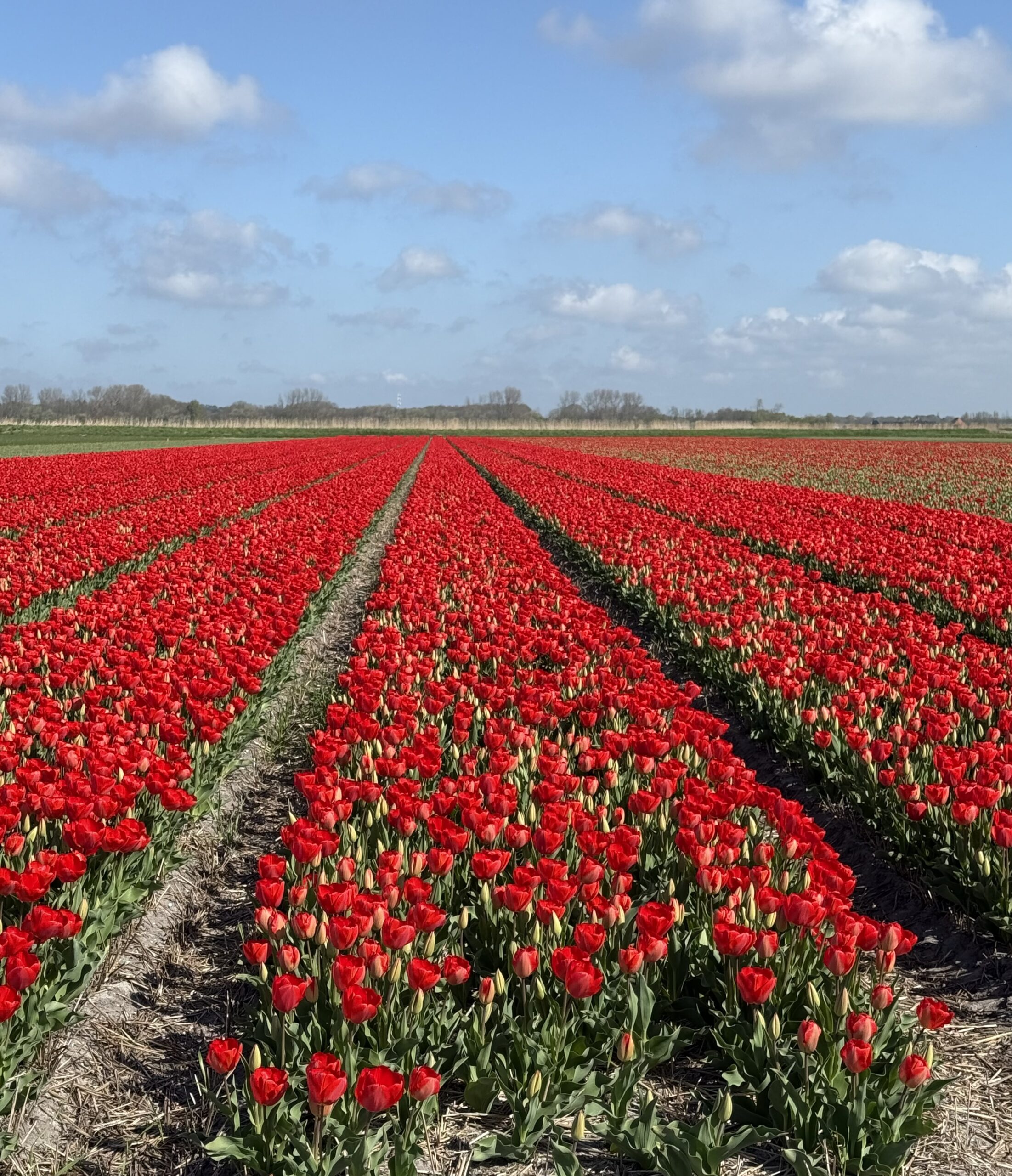
Nobody tells you this before you go. The tulip fields of Holland — those famous ribbons of color stretching to the horizon that show up in every travel magazine and screensaver — exist for one reason. The bulb. And to get the bulb, they kill the flower.
The blooms are allowed to open, briefly admired if you're fortunate enough to be there at the right time, and then they get whacked. Every one of them. The botanically proper term is "nipped," which is just a polite way of saying whacked. The Dutch even built a machine whose sole purpose is to do the whacking — a tractor with a cutting bar mounted at bloom height that rolls through the rows and shears off every flower head in its path. Whatever it misses, workers get by hand. The severed heads are left where they fall to decompose and add more nourishment to the soil. The plant, now convinced its work is done, stops sending energy to the flower and seed pods and redirects it underground, into the bulb. That's the whole game.
We went anyway.
Janet and I were there last April on Avalon Waterways' Netherlands in Bloom itinerary — less a traditional river cruise than a canal cruise, which suits the region perfectly. We arrived in Amsterdam two days early, ahead of the Bloemencorso. That's Dutch for Flower Parade. Yes, that's a real thing. Yes, it's exactly what it sounds like. In English. I don't speak Dutch so I can't comment on that.
I planned this trip meticulously, knowing we had about a one-week window — two at most — to catch the tulip fields in bloom. I studied the optimal tulip bloom time for the past five years, projected it forward to 2025, factoring in the seasonal weather forecast to gauge whether it would be an early season or late.
Once we locked in the dates we invited all of you to join us, and some did. Others followed along vicariously through our social media posts. I don't mind saying I was sweating it the entire way, until we got our first views of the tulip fields in full bloom on the second day of our visit. As careful as I was with the timing, each season is just a little different from the previous. And for a trip like this, a couple of days can make or break the experience. I built in margin to hedge our bets. Just in case. I needn't have worried. I was spot on.
The Trip at a Glance
Giorgio
I hired a private driver to take our group touring for the day before the cruise started. When the booking confirmation arrived, it was from Rudi's Taxi Company. My first thought: I'm paying for a private driver and tour guide and I've booked a cab. It didn't get better when I learned Rudi was sending Giorgio. Great. An Italian cab driver.
That was only half true. Giorgio was half Italian, half Dutch — and the Dutch half is the part we hired. A local with a local's knowledge of the places tourists don't get to see. Giorgio and I worked together to build a custom itinerary around one priority: the Bollenstreek. That's the stretch of countryside along the North Sea coast, roughly between Haarlem and Leiden, and an adjacent region to the north, where the commercial tulip fields are located. Giorgio suggested we visit Keukenhof Gardens. I said no, Giorgio.
We'd get to Keukenhof — it was included in one of the cruise excursions — but I hadn't engineered our departure date around a cruise excursion. I'd been to the region before and knew what I was working with: a narrow window before the nipping machines robbed us of the view. I'd built the whole trip around that window.
The first stop Giorgio made was at a tulip factory — and I mean that literally. The Dutch run the world's largest flower auction, supplying florists and wholesalers across the globe.
It was a family operation that had made a serious investment in automated machinery, moving tulips through each stage of production with the precision of an assembly line: bulb conditioning, pre-forcing, greenhouse forcing, planting, cutting. The whole cycle, under one roof, year-round. Temperature and light systems trick the plant into thinking it's whatever season the market needs. Bulbs go into chilled storage until they're called up for production, and when the flowers are cut the spent bulbs go straight to compost — unlike field bulbs, these never get the post-bloom nourishment that makes them worth replanting.
The family has a separate field dedicated to bulb replenishment. Each year, the best bulbs are set aside for the next season's planting. Their daughter bulbs go into cold storage until they're called up for production. The circle of life. Tulip style.
Somebody has to keep four billion stems moving.
The Hortus Bulborum
Next, Giorgio took us to the Hortus Bulborum in the town of Limmen, about 30 kilometers north of Amsterdam — an off-the-radar museum garden open to the public from March through May. It preserves hundreds of historic and rare tulip varieties, many no longer grown commercially. The tulips are cultivated in small, labeled plots, and we visited at peak bloom.
The range was remarkable: smooth petals, serrated petals, feathery petals, colors that have no business existing in nature. And they weren't created by meticulous cross-breeding or hybridization. The most striking varieties were the result of a virus.
Wait, what?
A virus. But rather than killing the bulb, it hijacks cellular machinery to suppress pigments, producing a bloom with streaks and feathers of orange bleeding through yellow petals like a flame. Probably why they call them broken flame tulips. The infected mother bulbs produce daughter bulbs that carry the virus, harvested year after year for propagation.
Janet, who has an opinion about everything, didn't say a word. That's how you know something is worth seeing.
Giorgio, being the local he was, knew which fields were at peak bloom and accessible by road, and he ended the tour by stopping at a few so we could take some pictures. The farmers here have a quiet understanding with visitors — you're welcome among the rows as long as you treat the plants with the same respect the grower does. No trampling, no picking, no selfie that requires kneeling on a bulb. We walked the rows slowly, which turns out to be the only sensible speed. Tulips as far as you can see.
That was day two. The cruise came next, and with it the windmills, the canals, and the cheese. All worth seeing. The cheese worth eating. But after a couple of days I was ready to get back to the tulips.
Keukenhof
And then there was Keukenhof. I'm not sure "garden" is the right word for it — that implies something manageable. This is 79 acres of controlled obsession, planted by hand, every bulb, every year. My back aches just thinking about it.
Seven million of them.
Some sections are formal, colors arranged with the precision of a paint-by-number at an impossible scale. Others look like someone tossed a basket of bulbs in the air and planted them where they landed — great loose circles of mixed colors that feel completely spontaneous. They're not. Every bulb is placed by hand to create the illusion of randomness. Intentional chaos, executed perfectly.
One planting stopped me cold. A winding ribbon of deep blue cutting through a green border — it looked exactly like a stream. Turns out it was made of 55,000 grape hyacinth bulbs with green shrubbery forming the banks on either side. The Keukenhof gardeners call it their blue river. Yep. I sort of caught on to that.
We spent the better part of the day at Keukenhof and could have spent more. Eventually, though, a person needs a souvenir.
When we travel, Janet collects refrigerator magnets. As much as we travel, the fridge door is nearly covered. I asked her once if we'd have to stop traveling when the door was full. She didn't even look up from her magnet. "We're gonna need a bigger fridge." That's an answer.
Two Hundred Holes
In addition to Janet's fridge magnet, we brought home some tulip bulbs. Two hundred of them. Or rather, we placed an order for two hundred while we were at Keukenhof. They arrived in October, right at the perfect time for planting. Our 200 bulbs pale in comparison to Keukenhof's 7 million, but my yard isn't 79 acres either.
Of all the tulips we saw, Janet and I both loved the look of the broken flame tulip. We loved it so much we made sure we included some in our order. So I've taken a virus from Holland and spread it to my garden.
Probably shouldn't have done that.
The bulb order was Janet's idea. Somehow planting them became my job. Typical. I dug the holes — all 200 of them, through what I can only conclude was a former quarry, judging by the rocks I had to dig around. Janet's job was dropping one bulb into each hole. Hers took considerably less time than mine, which meant she spent most of the afternoon watching me dig.
Then came the moles, the voles, and the squirrels, who apparently thought the sound of my tulip shovel pinging off the rocks was their dinner bell. We fought them off all winter. Then the deer showed up in spring with a taste for tulip greens. Couldn't have been dandelion greens. I would have served those up to them on a platter. But no, it had to be tulip greens.
Me and two gallons of Bobbex outlasted all of them. Two hundred bulbs went in. One hundred and ninety-four tulips came up. The six gaps in our carefully aligned rows are a tribute to the ones we lost.
I've decided Janet should handle the bud nipping and whatever else tulips require to look good from one year to the next. She isn't thrilled with the idea. I wasn't thrilled about digging 200 holes in a quarry either. I did it anyway. I'm glad I did. And now it's her turn.