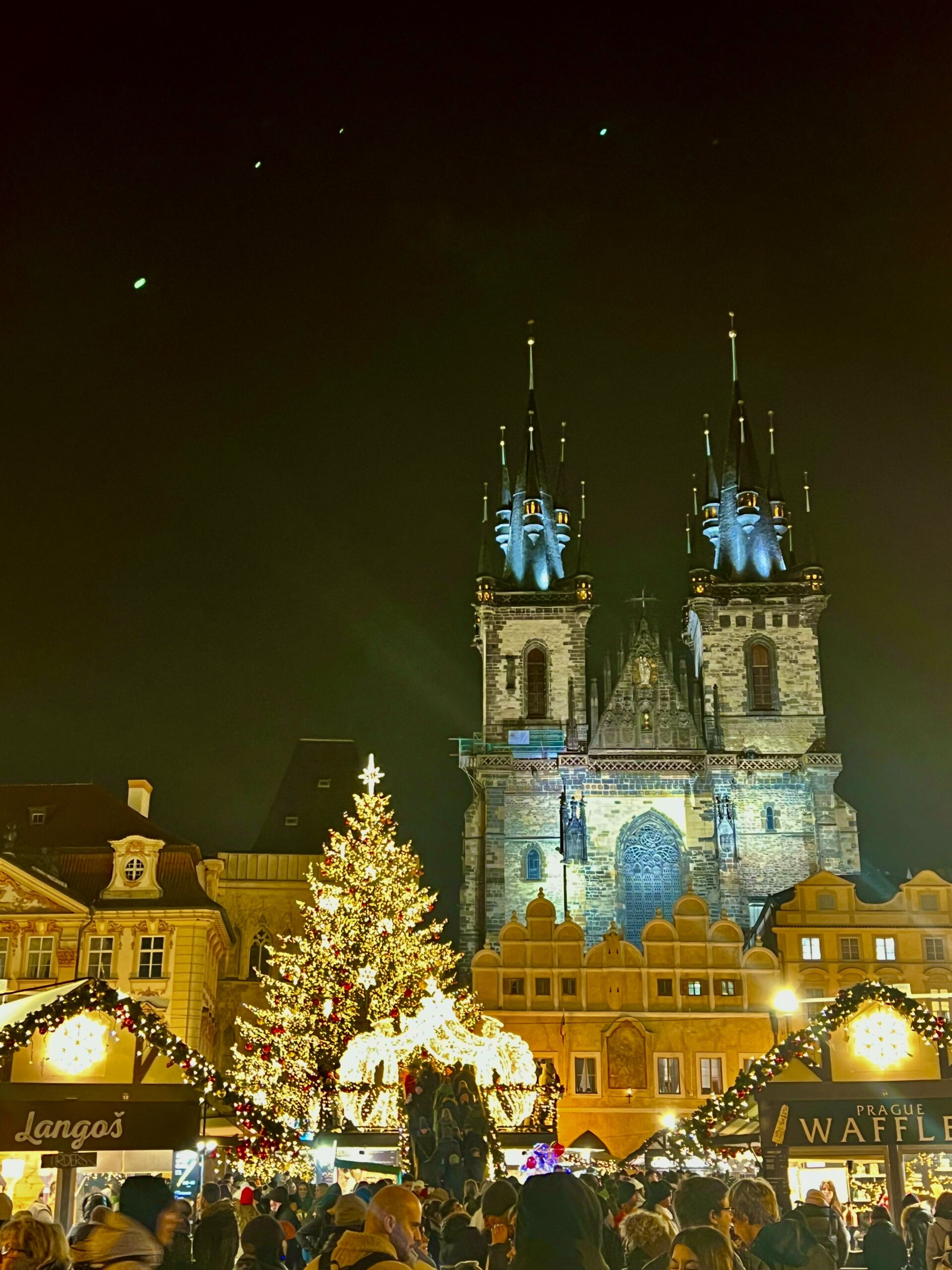
Janet took that photo in Prague's Old Town Square, and yes — it really was that magical. Christmas markets pop up in village squares all over Europe beginning in late November and running into the New Year. They started as a place for villagers to gather on cold evenings and share company, food, and warm mulled wine known as Glühwein — pronounced, accurately, "Glue Wine." I'm not a fan, though plenty of Christmas market aficionados love the stuff.
Christmas markets are magical places. Prague's Old Town Square doesn't need Cinderella's Castle — it builds its own kind of magic. The vendor stalls are the main draw: handmade crafts, linens, ornaments, and enough temptation to test anyone's luggage weight limit. Janet had wanted to experience Europe's Christmas markets for years, and our Danube River cruise with Avalon Waterways finally made it happen. Here's what we learned.
Christmas markets around the world started as gatherings for locals, but in Europe they've grown into big business. You'll find them in just about any small town and village, and in the big cities you'll find as many as half a dozen different markets. And then there's Berlin, with its record 42 markets throughout the city.
If you want to pack in as many markets as possible in a single week, a river cruise is the way to go. Each day you'll visit a new village or town, the ship docks in the heart of it, and the markets are a short walk away. Your ship is your hotel, so you unpack once. Avalon Waterways is our preferred river cruise line, and we've covered the reasons why in our ship reviews.
To maximize your time, you have to be willing to skip the included tours. Ship-organized excursions visit one or maybe two markets at each stop — but there are usually more available if you strike out on your own. We visited every…single…one. Well, almost. Janet tells me we missed a few in Vienna and Prague, but I don't know how.
Now — time for a reality check. Christmas markets have become increasingly commercial, with fewer local vendors, particularly in the larger cities. If you want an authentic experience, do your homework. The tips below are drawn from our trip.
The Trip at a Glance
Eleven Tips for Doing It Right
Food stalls are not the enemy
Many markets offered more food and drink than craft vendors — and that's fine. The smells and tastes are part of the experience. If crafts are your priority, pick the larger markets, which tend to have better representation from artisan vendors.
Watch for "Made in China"
It's one of the most common markings on market crafts. Seek out markets that feature authentic local artisans. Passau, Germany does this particularly well — the main market area features local crafts people, with a separate section for vendors from further afield.
Shop during the day
At peak evening hours, Christmas markets are wall-to-wall people with long lines at every stall. If you're a serious shopper, go during the day — weekdays especially. You'll cover more ground and actually see what you're buying.
Go after dark anyway
There is nothing more charming than a Christmas market lit up at night, and it's worth enduring the crowds just to see the lights. Nighttime visits are about the experience, not the shopping. Take your time, enjoy it, and yes — wait in line for your Glühwein and sausage.
Check the hours before you go
Most markets operate 11AM–9PM daily, but don't show up at 11 expecting everything to be open. Vendors take their time getting started. Noon is a safer arrival. And 9PM is not a hard stop — local stalls stay open as long as there's interest.
Skip the Glühwein mugs
Each market sells a unique collectable mug for the season, and it's tempting to grab one from every stop. Resist. They're cheaply made, break easily in your luggage, and once you're home you'll have a dozen vessels only good for one thing — and you're not drinking Glühwein anymore. You also pay a premium to keep the mug. Leave it.
Try the chimney cakes
Let your nose be your guide through the food stalls. Chimney cakes are Janet's and my favorite: strands of dough wrapped around a conical mold, baked, then finished with butter and cinnamon sugar. We've sampled them across Europe, and the best, by a fair margin, are in Budapest. Every version is worth trying.
Use cash
Most vendors won't accept American Express. Visa and Mastercard work, but after using a card at several market stalls our account was compromised. Cyber criminals are opportunistic and Christmas markets are a target. Cash is simpler. If you do use a card, monitor your account and flag anything suspicious immediately.
Aim for December 6th
St. Nicholas Day is when most of Europe celebrates its version of Christmas. Markets feature Nikolo — a bishop in red cape and miter, carrying candy for well-behaved children — and the Krampus, his considerably less cheerful counterpart. We encountered both in Passau. St. Nicholas gave Janet a chocolate figurine. The Krampus ignored her entirely.
Visit as many as you can
Each Christmas market is different — we never visited one that felt like a repeat. If you're doing this on a river cruise, choose an itinerary with overnight or late-evening stays so you can experience the markets after dark, and look for a mix of small-village and big-city stops.
Dress for the weather — and leave the umbrella behind
Markets run regardless of conditions. Dress appropriately, and if it's raining, wear a poncho. The markets are too crowded to use an umbrella without risk of hurting someone.