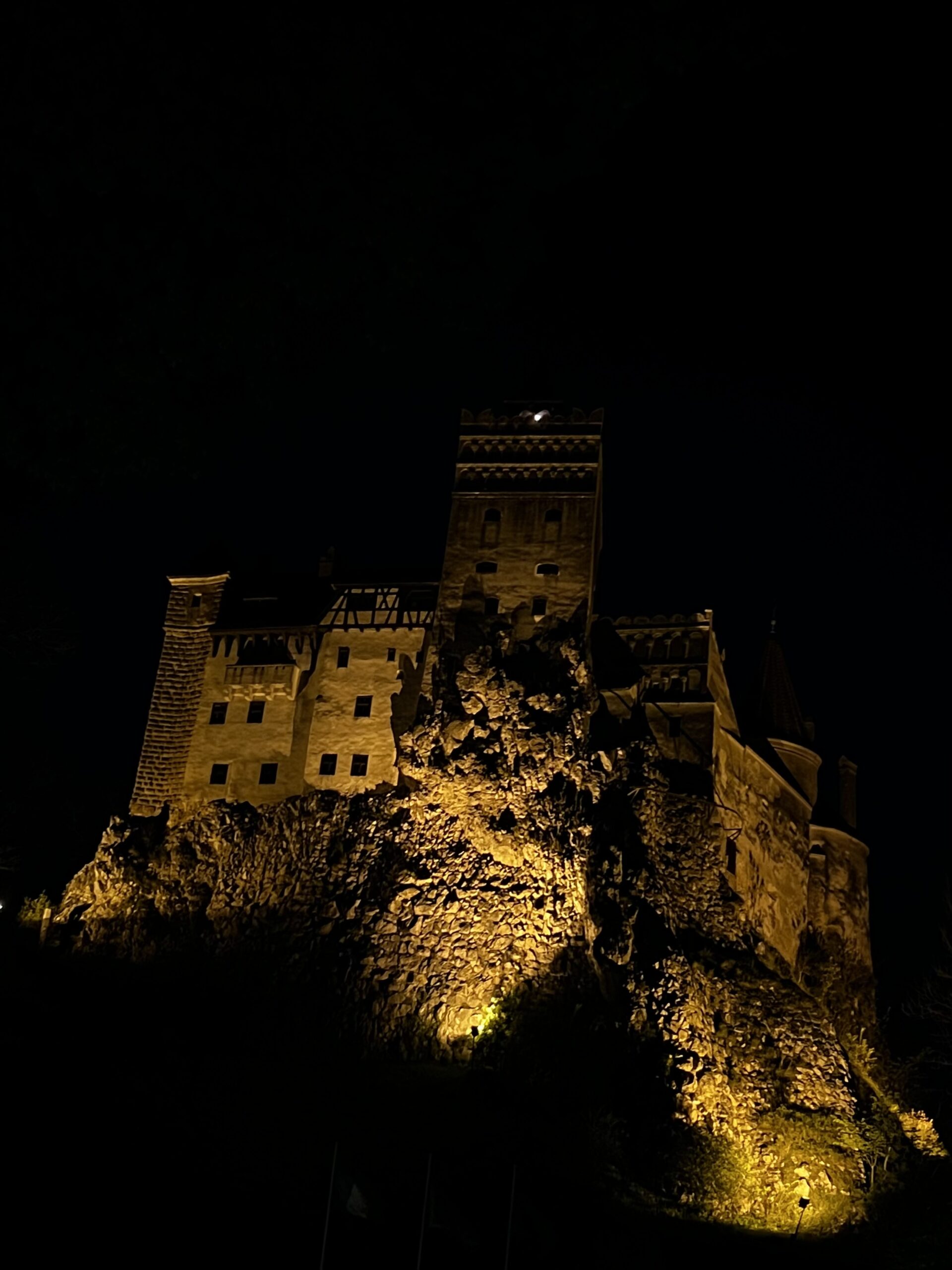
Transylvania. The mere mention of it conjures images of a blood-sucking vampire stalking a gothic castle in search of his next meal, racing back to his coffin before the first rays of morning light reduce him to a shimmering pool of evil goo. I'm talking about Dracula, of course. And make no mistake — Dracula is real. Or at least, he was.
I should confess upfront that I'm not a particularly devoted member of the Dracula fan club. I haven't read Bram Stoker's novel. I didn't watch Barnabas Collins in Dark Shadows as an impressionable adolescent. My most meaningful encounter with Dracula mythology was Sesame Street's Count von Count — and that was for the grandchildren. What drew me to Transylvania was something more interesting than vampires: the region turned out to be unexpectedly scenic and genuinely rich in history. The real kind.
If the name Transylvania still makes you uneasy, it might help to know it simply means "beyond the forest" in medieval Latin. That's an apt description. Transylvania sits in central Romania at the foothills of the Carpathian Mountains — peaceful, idyllic, and worth a one- or two-day excursion if your travels take you to Romania. Just be prepared. Not for vampires, but for stories about vampires. Romania's tourism industry has invested heavily in marketing Transylvania's starring role in the Dracula legend, and their efforts have been wildly successful. There are just enough real elements woven into the fiction to make the actual history genuinely interesting.
The Real Dracula
The Dracula story — the true part, anyway — starts in the late 14th century with Vlad II, ruler of Wallachia, a medieval fiefdom that still exists as part of modern Romania. His second son, Vlad III, would eventually inherit the title, and with it a nickname derived from his father's membership in the Order of the Dragon — a chivalric order founded by the King of Hungary, essentially the cool kids' club of medieval aristocracy. Vlad II was known as Vlad the Dragon, or in his native Wallachian, Vlad Dracul. His son became Vlad Dracul-a: Vlad, Son of the Dragon. You can see where this is going.
By most accounts, Vlad III was a reasonably benevolent ruler to his peasants — less so to the Saxon settlers in neighboring Transylvania who had raided Wallachia at the encouragement of Vlad's own mutinous noblemen. Vlad's response was to launch retaliatory raids, capture Saxon prisoners, and have them executed by impalement on spikes, bodies put on public display. Impalement was a cruel but not uncommon form of execution in that era. Blood-drinking after victory in battle was also practiced. Whether Vlad did either or both is historically murky. What's clear is that his enemies ran a very effective rumor-mongering campaign, the embellishments spread through Germany and Italy, and the legend of Vlad Dracul-a as an inhuman figure with a thirst for blood was born. By the time Bram Stoker was looking for a villain four centuries later, the legend had fully overtaken the man.
It's also worth noting that Vlad the Impaler — his best-known nickname, for obvious reasons — never lived in Transylvania. He lived in Wallachia. The Transylvania connection is Stoker's invention, chosen for its atmospheric resonance rather than historical accuracy.
Bran Castle, or: Why Let Reality Get in the Way of a Good Marketing Plan
Enter Romania's tourism industry, which selected Bran Castle as the "real" Dracula's Castle for promotional purposes. The choice was inspired, if not lacking any sense of historical rigor. Bran is a medieval gothic castle perched on a hilltop in a Carpathian mountain pass in Transylvania, silhouetted dramatically against the night sky — exactly as Stoker described. That Stoker's castle was pure fabrication, and that Vlad Dracul-a lived next door in Wallachia, was deemed unimportant. Local tour guides wax darkly poetic about vampires, and the tourists love it.
Historically, Bran Castle was built in the late 14th century by Saxon colonists to control a key passage through the mountains. By Vlad's time, its primary function was considerably less dramatic: it was a toll booth on a busy medieval trade route. Traders paid to pass. Which is, I suppose, blood-sucking in the figurative sense (pun intended).
None of that pedestrian history has deterred the tourism campaign, and honestly, fair enough. The castle is worth visiting — it's a genuine medieval fortress with spectacular surrounding scenery. Just set your expectations accordingly. There's nothing sinister about it in person. You can leave the garlic necklace and wooden stake at home. Or can you? I survived my visit. But maybe I just got lucky and caught it on a night when Dracula was out on a book signing tour.
The Part That Actually Surprised Me
The honest answer to why you should go to Transylvania has nothing to do with Dracula. The Carpathian foothills are beautiful in a way that rewards slow travel — forested mountains, medieval villages, and a history that stretches back to the Dacian civilization of the Iron Age. Control of the region changed hands so many times over the centuries that the running list reads like a greatest hits of European empire-building: the Huns, the Goths, the Slavs, the Bulgarians, the Hungarians, the Ottomans, the Hungarians again. Transylvania was rumored to hold the Dacian Empire's treasury of gold, and even after that proved elusive, it sat astride a key trade route through the Carpathians that made it worth fighting over for another thousand years.
We did our Transylvania touring as a two-day pre-cruise extension before boarding the Avalon Passion for our lower Danube sailing. Two days was enough to scratch the surface and leave wanting more. If your itinerary takes you to Romania, build in the time. The vampires are optional.