I told you I’d let you know.
In my last piece on this trip — written from the relative safety of my living room in Bel Air — I speculated that my expectations for this safari were “probably going to hold.” That was optimistic in the measured, self-protective way I approach most things. The truth is, as I confessed to Janet on the way to Tanzania, I wasn’t quite that confident. I had built up 50 years’ worth of expectations. That’s a high bar to clear.
I’ve sent enough clients on this exact trip to know that nobody comes back disappointed, which was reassuring. But knowing it intellectually and experiencing it for myself are two different things.
The Serengeti delivered.
Where We Went and Why
A quick note for anyone who’s done their own safari research: the Great Migration is most commonly associated with Kenya’s Maasai Mara, at the Mara River and in July and August. The Mara River crossing is extraordinary. It is also peak safari season, resulting in a traffic situation that rivals the Capital Beltway at rush hour.
We went to Tanzania, in June. Instead of the Mara River crossing, we witnessed the migration as the animals prepared to cross the Serengeti’s Grumeti River where there are more locations suitable for the animals to cross. And though there are more tourists than in rainy season, the competition for position is between single-digit safari vehicles and their drivers, not dozens.
The Great Migration follows the seasonal rains in a loop that hasn’t changed in more than a thousand years. By June the herds — two million wildebeest, zebra, and other grazers — are massing at the Grumeti River, building momentum before they push across to the other side of the river. It’s not the iconic Mara River cliff-drop that ends up on nature documentaries. For the animals it’s a warmup, but still a dangerous warmup. For me, it was the better choice.
Our guide Moses had a good read on the gathering herds. The morning of our first full day in the Serengeti he directed our driver Omar to an area just beyond view of the Grumeti River. The herds were massing in an open grassy area where they could feel the river’s presence. It put them on edge.
When we arrived, there were already a couple of safari vehicles parked along the trail. Omar did something counterintuitive: he drove past the gathered vehicles and positioned us quite a bit away from them. My first instinct was that we’d given up the best view. I should have known from our two previous game drives not to second-guess him.
The other vehicles had a better view of the arriving animals as the herd grew. We had a better angle to where the herd was ultimately heading. As we watched, the constant stream of arriving animals swelled the herd until it had nowhere left to go but forward. Away from the other vehicles and toward the river. Toward us.
What happened next was unexpected, even to Moses and Omar. The wildebeest began pressing in our direction. The closer they got, the more agitated they became. Suddenly, the herd began to walk past us, crossing the dirt road on their way to the river crossing. They didn’t cross in front of us so much as they broke all around us — going from contentedly grazing to agitated, to frantically running toward the river in a matter of a few minutes. Wave after wave passed us with such reckless abandon, that I’m surprised none of them slammed into us. The stream of animals split to pass in front of us and behind us, effectively surrounding us. Omar didn’t dare move. The risk of hitting an animal was high. So was the risk of an animal hitting us. We sat in the middle of the melee for close to an hour.
I put my phone down. Some moments you just have to live in. This was one of them.
The Big Five
The migration tends to overshadow everything, so let me be clear: that was only one part of one half of one day on our safari. We had daily game drives that were extraordinary from start to finish and only one focused on the Great Migration. The rest took us in search of Africa’s Big Five: lions, elephants, Cape buffalos, leopards, and the elusive black rhinoceros. Along the way, we took whatever Tanzania offered us: cheetahs, giraffes (lots of giraffes) and every variety of antelope possible.
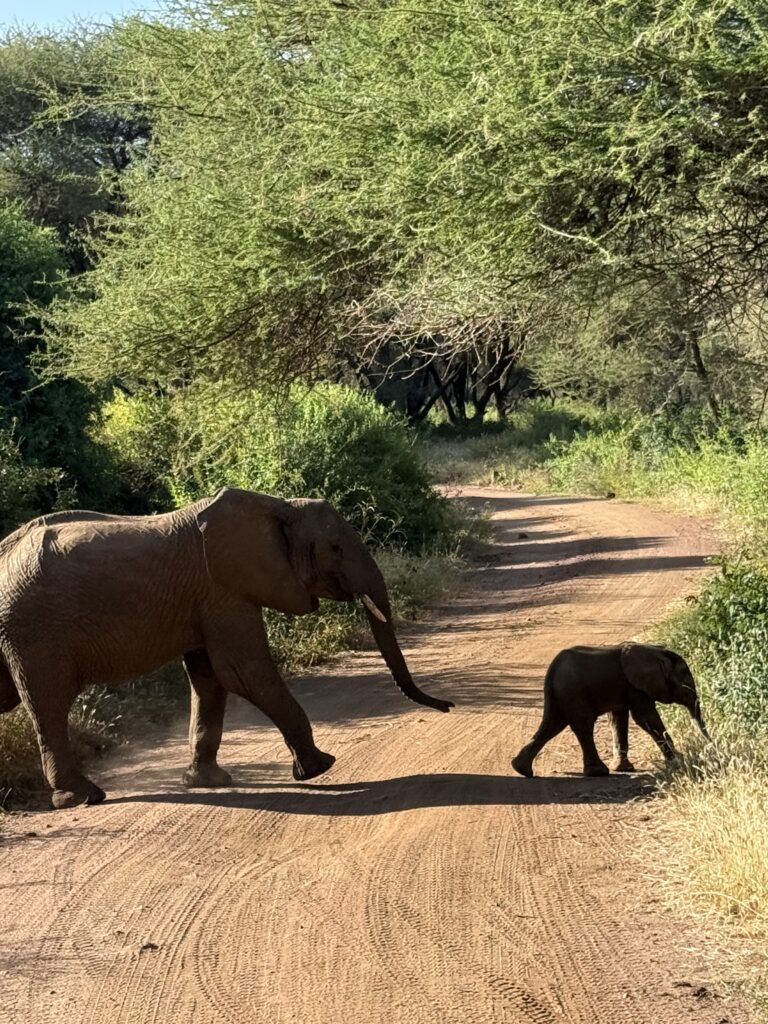
Lake Manyara National Park was our first destination. It is known for its tree-climbing lions, which we didn’t see. Moses compensated with a running commentary that turned every animal sighting into a character study. Baboons squabbling with each other and posturing for status in the family hierarchy. Elephants feeding along the side of the dirt road and then strolling down the middle of it as though they owned it, which in a real sense they did. Black-faced monkeys using their long tails to balance in the trees, and vervet monkeys scampering about. Moses shared with us that male vervet monkeys are also known as blue-ball monkeys. Having seen them, it was pretty obvious how they got the nickname.
We ended the day with one last elephant encounter, the most memorable of the trip. We were on our way out of the park when an adult bull elephant emerged from the brush. Moses alerted us to his presence, describing him in a perfectly deadpan voice as a “five-legged elephant.” As he broke free of the brush we could see why Moses described him that way. It took Janet a moment longer than the rest of us to figure it out. She got it eventually, after seeing him, and responded with an embarrassed, “Oh.” We watched as he ambled onto the dirt road, expecting him to cross behind us at comfortable distance, which he did. And then he proceeded to turn and walk right alongside of us, towering over our Land Cruiser as he passed toward the front. He was close enough for us to reach out and touch him, though he seemed oblivious to our presence. We weren’t a threat. Just an obstacle to be avoided, and we soon realized why. He was heading toward a female elephant waiting for him in front of us and on the opposite side of the road.
The next day was all Serengeti, and lions. Several encounters, each one raising my adrenaline level a bit more than the previous. We found the tree climbing lions, not in Lake Manyara where we expected to find them, but in the Serengeti. After that, it was a lion pride lounging in the grass that gave us a “cub-trailing-its-mother” photo op and a whole new level of cute. Perhaps the most thrilling, for me at least, were the two adult male lions we encountered. They were lying in the grass near an eland kill. And it was freshly killed. The eland is the largest of the antelopes, meaning the two bachelors were sitting on a week’s worth of leftovers.
As we joined several other vehicles who were in position to watch, one of the males slowly got up and circled first one vehicles and then another. Ours. He paused long enough to sniff the sideboard of the first vehicle, and when he moved on to ours the six of us held a collective breath. He paused in the shade of our vehicle for a moment. And just like that he moved on. Then Omar moved on.
Omar didn’t leave the scene after our close encounter with the lion. He strategically repositioned us away from the other vehicles, lining us up with the eland carcass. Almost as soon as he shut off the engine, the second lion got up and headed to the eland for seconds. We were perfectly positioned to capture some of the best pictures and video of the trip as the lion approached the eland and then dove in, burying half of his face in the kill.
It was fascinatingly gruesome to watch as he tugged muscle and sinew from the eland, and to hear the crunch of bone as his strong jaw muscles and sharp teeth clamped down on the eland’s ribs. Moses said later that seeing lions on a kill that large and that fresh was a rare treat. Janet begged to differ with his characterization of the scene as a “treat.” She had her eyes covered the entire time the lion was feeding.
Leopards, when we found them on our second day in the Serengeti, were draped in the branches of an acacia tree with the completely relaxed posture of cats who have eaten extremely well and wanted nothing more than to be left alone while they digested it. An occasional ear-flick the only proof of life they offered.
We saw the last of the Big Five on our final day, in Ngorongoro Crater. Each of our previous Big Five sightings had been up close. The black rhinoceros sighting was from a distance, but even so the rhino’s distinctive profile was visible without binoculars. Once numbering in the tens of thousands, poaching drove them to critically low numbers by the 1990s. Anti-poaching measures have allowed the population to begin recovering, but they remain threatened. Which is why they are the most elusive of the Big Five. We watched as the rhino turned his head from side to side, taking in his surroundings, and then grabbing a mouthful of grass. Unbothered, and unhurried.
In between the Big Five sightings we encountered more giraffes, zebras, ostriches, antelopes than I could keep count. We even saw a porcupine, alive but mortally wounded by what Moses said was probably a leopard attack. Quills scattered over the road evidence of how hard he fought. And why the leopard didn’t stick around to finish the job since more than a few quills undoubtedly hit their target. We drove back that way later the same evening, just in time to see a jackal grabbing what little remained of the porcupine. In the Serengeti nothing goes to waste.
And hippos. Hippos by the dozen at a watering hole, submerging like a submarine executing a crash dive. Except the hippos didn’t purge ballast to sink under the water. They passed gas, filling the air with a smell I can only describe as industrially sulfurous. They can be among the most dangerous animals in Africa, though you wouldn’t know it from the comical antics and sounds we witnessed.
About the Accommodations
My image of safari lodging was rustic, roughing it. The reality was quite different. We started in a four-star hotel in Arusha for the days before and after the safari. During the safari our accommodations were not quite four stars, but they were a far cry from roughing it. Each place had ensuites with running water and a shower with hot water. All but the first one had 24-hour electricity, and all offered wifi.
The first and last night’s lodging locations were safely outside the national parks. In between we stayed two nights at the Serengeti Tortilis Camp, inside the Serengeti National Park and surrounded by the very animals we sought out during the day. The Tortilis camp was a tent camp, where the “tents” consisted of semi-luxury glamping. On our way to the camp, I asked Moses how the staff kept guests protected from the animals. He described the protective measures: a firebreak around the camp perimeter, and spotlights mounted on poles. In my mind it was the kind of set up that tells the wildlife “Keep Out.” A member of the camp staff kept an eye on things through the night while the rest of us slept. Or tried to anyway.
The reality of the camp’s protective measures was nothing like the image I formed based on Moses’ description. The briefing we got from the camp staff upon arrival was my first clue. Walk freely during daylight. After dark, escort required. I thought that was theater. I was wrong. I wouldn’t realize the full extent of how much I had over-imagined the security perimeter until the next morning. The “fire break” turned out to be a gravel path that ran past the row of glamping tents, the spotlights mounted on poles were nothing more than solar powered landscaping lights. The decorative kind like I put around my patio that can’t even intimidate the fox that calls my yard home.
I woke at midnight to sound of hyenas in the distance. Far enough away for me not to be concerned. Until I heard the low grunts of Cape buffalo that were considerably closer. Close enough for me to hear them chewing the grass that grew just beyond the gravel path past my tent. When a breeze moved the tent walls I briefly became convinced a buffalo had figured out how to unzip the flap. It hadn’t, and I said a quiet prayer of thanks that God had not given them opposable thumbs.
In the morning Moses mentioned — almost as an afterthought — that buffalo come into camp at night because human activity deters the lions that live nearby. What lions? He hadn’t said anything about that the day before. The buffalo use us as protection from the lions. Not exactly a comforting thought.
While I’m glad he waited until morning to tell us that, I kind of wished he hadn’t told us at all. We still had one more night in the camp to get through.
Night two: no buffalo. Lions — a fact I confirmed by sound while lying awake trying not to totally freak out. Multiple lions calling to each other at what I generously assessed to be a safe distance. Leaving camp the next morning, I realized how wrong I was. Our Land Cruiser had barely cleared the camp entrance when Omar stopped. Three lions were approaching us. A mature lioness and two adolescent males just starting to get their manes, probably her offspring. The lioness and one of the males passed without a glance our way. The remaining male walked up to the vehicle and spent a few minutes grazing on some grass maybe a foot or two away from us. An odd thing to see an apex predator munching on grass. His attitude communicated that he found us entirely unremarkable. To him we were merely part of the landscape. Not a threat, not prey. Just something boring to be ignored. Probably the only time I’m glad to have been considered boring.
The camp delivered on my hope for authenticity. More than I’d bargained for in fact. Deliciously more.
The Part That Surprised Me Most
A safari will show you wildlife in their native environment. Ours also showed us Tanzania and her people.
The first day included a stop at a village called Mto Wa Mbo — rice fields, banana farms, a lesson in how a barter economy operates when cash is scarce, and lunch prepared by what Moses called the mama anapika, the mother cook. Tanzanian food does not appear in most cuisine or travel writing, but it should. It was quite tasty and satisfyingly filling.
The last day brought us to a Maasai village. We’d passed one the day before — Moses pointed it out specifically, a model village set up for tourists complete with an admission fee and trinkets for sale on tables. The village we visited was not that. It was authentic. Not only did the Maasai we visited have no expectation of getting any cash from us, they would have been insulted had we offered.
As proud as the Maasai are as a people, they are practical. G Adventures runs a program in partnership with National Geographic called the clean cookstove project. A traditional Maasai mama anapika cooks over an open fire set between three stones on the dirt floor of the boma, their mud and stick hut. Functional for heat and cooking; terrible for venting smoke which has nowhere to go. The result is elevated respiratory disease. The clean cookstove project replaces the three-stone setup with a brick stove vented outside through the boma’s roof. Each G Adventures tour group funds one clean cookstove and we were visiting the village where ours was to be installed. While there, we were invited to help install it.
“Help install” is generous phrasing. Mostly we hauled bricks while the project engineer — a Maasai woman — did the actual work. The village elders decide who receives each stove. Families with resources provide for themselves; the G Adventures stoves go to those who can’t. It preserves the tribe’s self-sufficiency while directing help where it’s needed. Prideful but compassionate.
Rather than giving the children of the village candy or toys, we were encouraged to photograph them and then show them the photos. The Maasai have no use for mirrors; for many of the kids, a phone screen is the first time they’ve seen what they look like. It’s a more rewarding treat for them than any piece of candy ever could be.
I’ve been on similar tours that feel like cultural exhibits. This wasn’t one. You could see it in the expressions on those children’s faces when we showed them their pictures. And the smiles. Unforced, shy but genuine and ever present.
What You Should Know Before You Go
A few things worth knowing if you’re considering your own African safari:
We started planning in earnest four years in advance and booked two years before departure. That’s not a requirement — but it’s not an accident either. Good itineraries at small group sizes sell out. If you want a specific departure date with a specific guide outfit, early planning is your friend.
We went with two other couples. Together the six of us commanded our own Land Cruiser. Well, Moses and Omar commanded it. But they gave us a vote periodically. Traveling with friends when you’re spending long days in the close quarters of a Land Cruiser is important. Group chemistry is not a minor consideration. The cohesiveness of our group made Moses and Omar’s jobs easier. And our banter gave them more than a few laughs along the way. They got as much out of us as we did out of the Serengeti.
Tanzania requires some pre-trip health planning — anti-malarial medication, a handful of vaccinations depending on your travel history. Not complicated, but not something to ignore two weeks out. I’ll spare you the travel medicine clinic story since I covered it in my blog post, except to say your family doctor and your pharmacy will handle most of it, and if you’re old enough, Medicare will probably cover the cost as it did for us.
As for the khaki situation, I have no regrets about all the khaki we bought. I wore every bit of it and wished I had more.