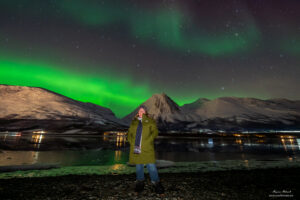
I remember looking up at the sky and wondering why our guide was so excited. We were north of the Arctic Circle — about 300 kilometers north and a bit west of the Norwegian-Finnish border. We had been riding in a van with twelve other people for nearly an hour and a half. In the middle of the night. Our guides had barely finished setting up chairs and a small fire pit on the snowy bank of Balsfjorden when one of them pointed her camera skyward and let out what I can only describe as a squeal of pure delight.
I looked in the same direction and saw nothing but sky with some grey wispy clouds. Scenic sky, to be sure — stars sharp as pins peeking through the occasional sheet cloud over snow-covered mountains, the kind of scene you find on a postcard. But squeal-worthy? I wasn’t convinced. I pointed my iPhone toward the spot the guide was looking at and glanced at the viewing screen. And then I squealed.
Those clouds I thought I was seeing weren’t clouds at all. They were vivid green whorls spiraling over those same snow-covered mountains. Sheets of purple and red seemed to rain down through the green. The Northern Lights! I had been wanting to see the Northern Lights since I was a child, and now I was watching them dance over an Arctic fjord. It was everything I hoped it would be, and nothing at all like I expected.
Your Time Is Running Out. But You Still Have Time.
If seeing the Northern Lights is on your list, you are in the last viable window of a rare and exceptional solar cycle. We are currently in the declining phase of Solar Cycle 25 — the most active cycle in a generation — and the window for reliably vivid auroral displays begins to close around March of 2027. The next solar maximum isn’t expected until the mid-2030s. If you want to see the Northern Lights at their best before then, now is the time to plan.
The Northern Lights are a year-round phenomenon in high-latitude regions, and the solar cycle is only one part of the equation. The season, local weather, light pollution, and your latitude matter far more on any given night than where we happen to be on the sunspot chart. What the current cycle gave us — and what we are still benefiting from — is a higher baseline of auroral activity, more frequent intense displays, and a stronger likelihood of seeing something impressive on any clear night under an auroral oval that occasionally stretched out to cover half of the U.S. It is the beginning of the end for that advantage. The 2026–27 season won’t match the celestial fireworks of 2024 and 2025, but it is a strong, legitimate aurora travel window — better than anything you’ll find from roughly 2028 through 2033.
The key phrase is declining, not done. Go now. Well not now. You won’ see anything if you go now. The Northern Lights will still be there, but it won’t get dark enough to see them again until September. Plan now, go then.
The Right Time, The Magic Number
Within the viewing season, some windows are better than others, and this is where the science comes into play.
In The Hitchhiker’s Guide to the Galaxy, 42 is the answer to the ultimate question of life, the universe, and everything. A totally random number. Not science, just a little sci-fi humor. For planning a Northern Lights trip, the magic number is exactly half that, 21 — and that’s not science fiction. There is real science behind that number. It is the date of the vernal and autumnal equinoxes.
The equinoxes — March 21 and September 21, give or take a week — are the single best times to plan a Northern Lights trip. Fewer hours of darkness than midwinter, yes, but that is offset by what astronomers call the Russell-McPherron effect. For a few weeks around each equinox, the geometry of Earth’s magnetic field relative to the solar wind becomes more efficient at funneling energy into auroral displays. Think of it as a seasonal express lane opening up for the solar energy that causes the lights. This holds regardless of where we are in the solar cycle, which means the weeks surrounding the equinoxes are the most predictable targets you have when you’re trying to book a trip a year in advance. At the end of the day though, weather, darkness, and latitude still matter more on any given night than the calendar alone.
For the upcoming Northern Lights viewing season, September 2026 and March 2027 are your bookend months. The full polar night period between November and February is also ideal, offering far more hours of darkness. If you want total immersion rather than optimal solar timing pick November through February. If you want to hedge your bets, go with the week surrounding the equinoxes — September or March.
I planned our Tromsø trip around the spring equinox of 2025, and we were rewarded with a geomagnetic storm that had us and our guides squealing in wondrous delight. The equinox didn’t guarantee that. But it stacked the odds in our favor.
The Right Place
When clients approach me about a Northern Lights trip, most tell me they want to go to Iceland. Credit where it’s due: the Iceland Bureau of Tourism has done a masterful job selling the image of tourists soaking in volcanic hot springs while the aurora ripples overhead. Those photos are real. But they were taken by professional photographers who live there, who can head out at 1 AM when conditions align (once or twice per viewing season), and who drive well outside Reykjavík to escape the clouds and light pollution. That is not the typical tourist experience in Iceland.
The best place follows directly from the science: get under the auroral oval. That’s the band surrounding the magnetic North Pole where aurora is present on the majority of clear nights throughout the viewing season. Most of Iceland lies south of the Arctic Circle and sits just south of the oval’s reliable reach except during geomagnetic storms, when the auroral oval pushes further south. To get under the auroral oval reliably, you need to go north of the Arctic Circle— northern Norway and Finland are the premier destinations.
Within Norway, two towns stand out for ideal Northern Lights viewing: Alta and Tromsø. Alta has been given the nickname of the Northern Lights capital of Europe, probably by the Alta Chamber of Commerce. To be fair, it is located well above the Arctic Circle, served by multiple daily flights from Oslo, and has a microclimate that leads to patches of clear skies more often than almost anywhere else in Norway. Except maybe Tromsø.
Tromsø is 350 kilometers north of the Arctic circle and about 170 kilometers away from Alta. It is a larger settlement than Alta, a small city in truth, offering more accommodation options, and more things to do when you aren’t out hunting the Northern Lights. Like Alta, Tromsø has its own fjord-driven microclimate producing patches of clear skies when the rest of the region is clouded out, providing essentially the same viewing conditions as Alta. The guides operating out of both places report an 80% success rate for their Northern Lights hunts. That number is remarkable given that winter in the Arctic is not exactly synonymous with clear skies on a predictable basis.
The Right Viewing Conditions
Getting to the right place at the right time is necessary, but it is not sufficient. You still have to find clear sky. Or at least patches of clear sky.
Light pollution is the enemy you can manage. The best Northern Lights tour operators will take you well away from city lights, and in northern Norway and Finland that’s not difficult — there isn’t much out there to begin with.
Weather is the enemy you can’t manage, only outmaneuver. That’s why they call it Northern Lights hunting. The prey in this case is clear sky. The Northern Lights occur at altitudes of 90 to 300 kilometers. Clouds live well below 18 kilometers. Simple rule of thumb: if you can’t see stars, you won’t see aurora.
The weather in northern Norway and Finland during the Northern Lights viewing season is one big trade-off. You get more clear sky nights in September and March than you do November through February, but fewer hours of darkness. More cloudy weather November through February but more hours of darkness during polar winter.
Weather is why time at the destination matters. A three-day trip to Iceland, or anywhere else, leaves you vulnerable to a single bad-weather stretch that wipes out your entire window. The most spectacular auroral events can be happening right over your head, but you won’t see them. Plan for a week, longer if you can. And book a Northern Lights hunt for every night you’re there — don’t save one for “if the weather is good” because often the weather is lousy when you start out, yet the better guides manage to find clear skies more often than not. They might have to drive for a couple of hours and cross a border, but they are nothing if not persistent. And each night’s display will be different than the previous one.
Most of the reliable Northern Lights hunters allow you to cancel without penalty with 24 hours’ notice. If you book a week of hunts and get your fill of the aurora after the first two or three, cancel the rest and go snowmobiling. You can still sleep in. Nobody’s going to judge you.
Alta and Tromsø Northern Lights hunters have a range of sophisticated, and some not-so sophisticated, aurora forecasting tools to rely on. From a network of hi-tech spotting cameras set up throughout the region pointing skyward, to the human’s eye view accessed by a low-tech phone-tree. They won’t always succeed. But they succeed far more often than a traveler who stays in one spot and hopes the clear sky finds them. That rarely works out.
During our trip, the aurora forecast for our first night out was poor. Shortly before we headed out, the guides got word that energy from a major solar event would be hitting the atmosphere over the next three days. The forecast hadn’t predicted it. The guides knew to look anyway. They took us out in spite of a forecast of solid cloud cover, found the patches of clear sky, and we were rewarded with some spectacular displays. That’s what you’re paying the hunters for.
Another option worth mentioning: Hurtigruten, Norway’s storied coastal ferry line, offers dedicated Northern Lights cruises with a guarantee — if you don’t see the lights, you receive credit toward a future sailing. Of course there are strings attached to that guarantee. They cruise even further north than Alta or Tromsø, giving you an even better shot at seeing the lights. The downside, they operate on a fixed schedule and path. They can’t go on a hunt for clear skies. They best they can do is hope to sail into them.
Alaska and Canada
You don’t have to cross the Atlantic to see the Northern Lights. Coldfoot, Alaska and Yellowknife in northern Canada both offer genuine Northern Lights experiences. Coldfoot is north of the Arctic Circle, Yellowknife sits just south but still usually under the auroral oval. Neither destination will save you time or money over Norway or Finland once you factor in routing. But if geography or preference keeps you on this side of the world, both are real options. We work with suppliers who have set up successful Northern Lights hunts for our clients visiting Alaska in the winter.
Once You’re There
The planning gets you to the right place at the right time. What you do when the lights appear determines the quality of your experience. Here are a few things I learned the hard way and would prefer you didn’t have to.
What your eyes will and won’t see
How to view the Northern Lights is the most important thing I can tell you, and most people don’t know it going in. When I first looked up at the sky to see what the guide was getting excited about, all I saw were some sheets of wispy white and grey clouds. Under normal auroral conditions, the human eye does not see the Northern Lights in color. I didn’t for most of the displays we saw.
The rod cells in our eyes are extremely sensitive to light, but they can’t detect color. They only see in black, white, and shades of grey. The cone cells that add color to our vision require much more light energy to trigger them, at which point they detect and resolve colors. The conundrum is that the Northern Lights are low level light generated by the release of photons resulting from charged solar particles colliding with the nitrogen and oxygen in our upper atmosphere. It’s not like sunlight, or even the reflected sunlight that illuminates the moon at night. The aurora is its own light source, but it is usually so weak we see the light but not the color.
When enough photons are released in response to particularly high volumes of energetic solar particles, like the energy that hits our atmosphere from a geomagnetic storm, enough photons are released to activate our cone cells and we see the lights in color.
Digital devices are much more sensitive to light and color detection than our eyes. When you hold your cellphone camera up to the sky during an aurora display, it’s like Dorothy stepping out of her house after the tornado landed her in Munchkin land. Black and white suddenly turns into full living technocolor.
In the auroral displays we witnessed over two nights, I occasionally saw the aurora in color without using my camera. When I did, the color was mostly green. What I saw with my eyes was striking. What I saw on my phone’s viewing screen was stunning.
Which brings me to the single most useful tip I can offer: look at the sky through your camera. Even a basic smartphone camera can detect and display auroral color at light levels well below human vision. Point your phone at where you think the lights might be and check the viewing screen. If the aurora is there, you will see it in vivid, saturated color. What your eyes read as grey clouds, your camera will show as green fire and purple rain. The two photos below illustrate the point — the first representing what my eyes saw looking directly at the sky, the second showing exactly what my camera captured from the same scene at the same moment.
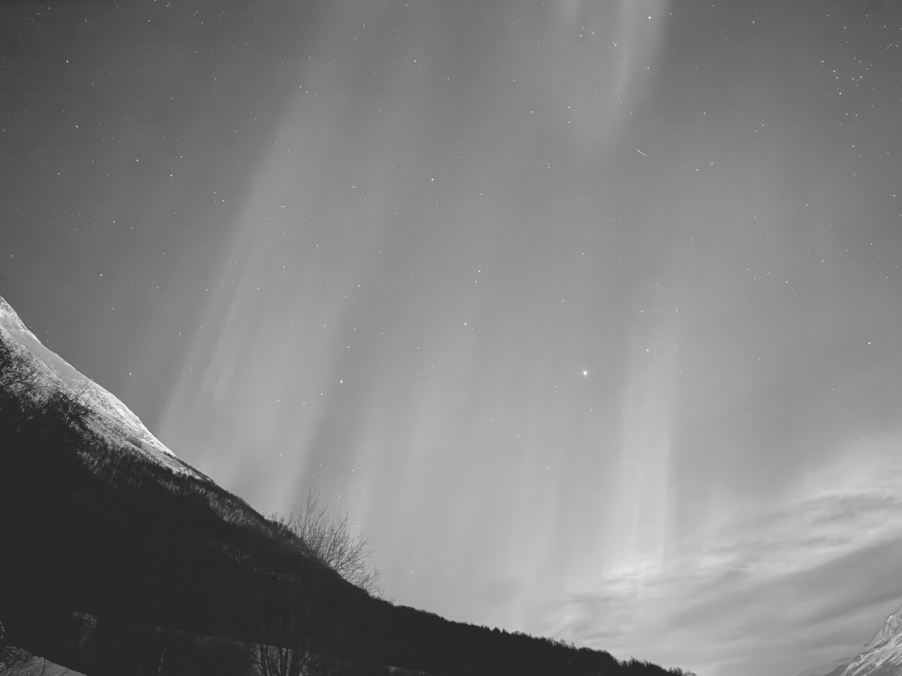
What the naked eye sees.
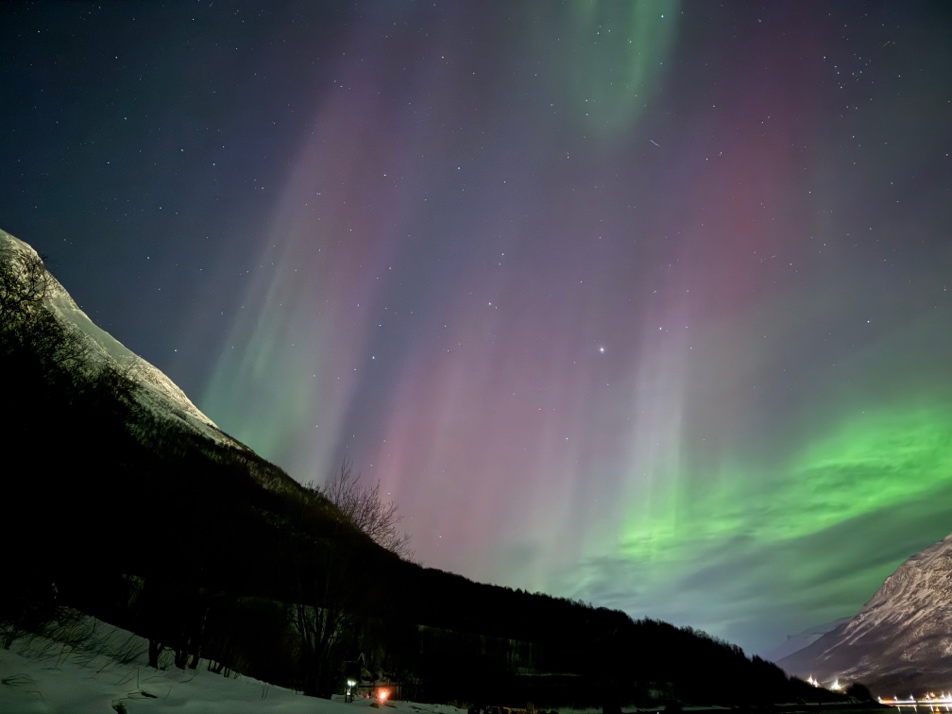
Same image with my Apple iPhone Pro Max15 on tripod, 10 second auto-exposure.
Use a tripod. I learned this on night one, when every photo I took — iPhone 16 Pro Max, night mode, ten-second exposure — came out just a touch blurred because I couldn’t hold still long enough. Night two, tripod. The difference was significant.
Choose your guide carefully
The quality of your Northern Lights experience depends more on your guide than on almost any other factor you can control. The best operators use local guides who know the microclimates, maintain networks of cloud spotters, that phone tree, and — critically — are not locked into fixed viewing locations. A tour that drives you to a parking lot with permanent facilities and restrooms may be more comfortable. It will also park you in one spot regardless of what the clouds are doing overhead. The better operators keep their vehicles moving and their options open, and the best guides are empowered to call an audible when conditions change.
On our first night we used a company that had a Romanian driver and a Romanian guide. Not locals. Both were in their first season of running the hunts. They also had no field toilet and we made just one brief comfort stop, on the way to the aurora. We found clear skies, though it is more accurate to say clear skies found us. The experience was amazing, but it was in spite of the guides rather than because of them. And it turned out to be just a warmup for the next night’s event.
On our second night we booked with Arctic Circle Tours Tromsø. Local driver, local guide, fully mobile operation, and robust network of local cloud spotters all the way to the Finland border. They checked in with their family and friends, identified where the skies were clear, then took us there. When we arrived, they gave us snow suits and while we put them on, the guide and driver set up chairs, a fire, and a camp toilet with a heated privacy tent on the bank of a river. We were as comfortable as you can get standing around in knee-deep snow on the banks of a Norwegian fjord on a cold early spring night.
Northern Lights hunts typically last six to eight hours. We drove about 90 minutes which meant three and a half hours of actual viewing time. You might think it would start to get boring after the first hour of aurora watching, especially in the cold night air. It doesn’t. Not even for our guides who see them almost every night they go hunting. When we were heading back our guide spotted fresh green ribbons on her dashboard cameras, the hi-tech part of their operation. She directed the driver to drop us at a wooden pedestrian bridge she knew nearby. We spent another fifteen minutes photographing aurora over snow-covered ice with a bridge in the foreground. You don’t get that from a parking lot.
It’s Nature
The Northern Lights will humble every plan you make. You can do everything right — right destination, right timing, right guide — and still come home with pictures of clouds. That possibility is part of the deal. It’s also why you should plan to stay for more than just a few days. The longer your stay the greater the chance of a successful Northern Lights hunt. And plan a trip with enough daytime substance that it’s worth taking, even if the aurora doesn’t cooperate. Northern Norway in winter is not a consolation prize. The snowmobiling alone was worth the trip.
Go. The window is closing, the science is still with you, and these things are genuinely as extraordinary as everyone says. I’ve been wanting to see them my entire adult life. Now, having seen them, I keep pinching myself. Don’t be the person who had the chance and didn’t take it. If you miss this window, your next shot at ideal conditions won’t come around again until the mid-2030s. And there’s no guarantee that cycle will be as active as the one that’s just now ending.