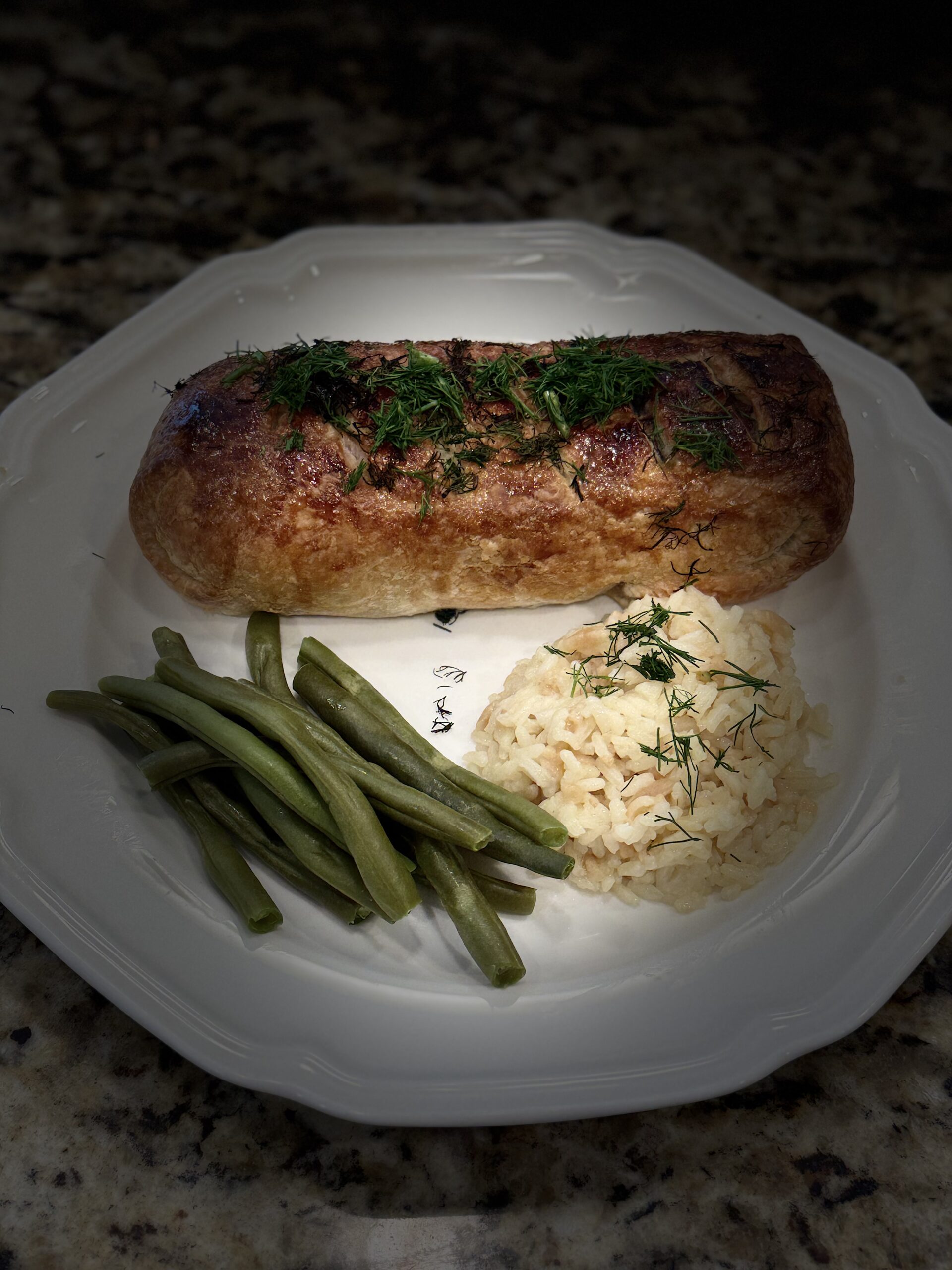
Watch Out for Soggy Bottoms
A Wild Alaska habit, a design-flawed pastry, and the fix that finally worked.
I like salmon. I like it a lot. Now. As a kid, I tolerated it. Probably because when my mother made salmon, she used canned salmon. Fortunately, those salmon nights in our house meant far less drama than the Campbell's pork and beans nights. I could handle the salmon without gagging. My mother did her best to make the canned salmon palatable: she made it into salmon burgers. And to make it worth eating, she made macaroni and cheese as a side dish. I had to eat the salmon burger to get to the mac and cheese, and what kid can't handle that? She never tried to bribe me with mac and cheese to get me to eat the pork and beans, for which I am eternally grateful.
Janet loves salmon — she could eat salmon every night of the week — and back in the days when she did the cooking for us, it wasn't the canned stuff. Fresh filets, baked in the oven, whatever seasoning she felt like sprinkling on it. That was my introduction to real salmon, and I quickly learned fresh salmon tastes nothing like the canned stuff I ate as a kid. It tasted like something I wanted to eat, not something I had to eat, to get to the mac and cheese.
I made sure, once our kids were old enough to eat whatever Janet cooked, that she made mac and cheese whenever salmon was on the menu. The bribe worked for me, and it worked for our kids as well. Mostly.
For our summer vacations, once the kids grew out of stopping in the mud to make bricks the old-fashioned way at Colonial Williamsburg, we began to take cruises. And in those days, dinner on a cruise ship was a special occasion for all of us. The boys loved dressing up for dinner, still a thing on cruise ships back then. On one cruise in particular, both boys decided they were done with the kids' menu. The cruise lines did a great job accommodating Rob's milk allergy, but when it came to the protein, Rob made it easy on them. Steak. Every night. Chris, to our surprise, ordered salmon every night, and cleaned his plate each time.
The last day of that cruise was the last day Chris ate salmon. The only thing kids are consistent about when it comes to food is how quickly their tastes change. Of course, he's an adult now with his own child to raise, and I don't know how he feels about salmon. I know our grandson Owen loves mac and cheese, so at least that tradition has been passed along. We're working on the steamed crabs.
Living on the East Coast, the salmon we buy locally is farm-raised Atlantic — and we liked it fine until we discovered wild caught Alaskan salmon. Back when Rob was in college and Chris had just graduated high school, we took an Alaskan cruise with the kids and Janet's parents. I'd promised Rob and Chris an ocean fishing excursion during that cruise, and fortunately they were old enough to go on their own. The one and only time I'd gone deep-sea fishing was on our honeymoon, which was when I discovered I get seasick. It took me 12 years to learn that I could handle a cruise ship, with medication. I wasn't about to test fate, or modern pharmaceuticals, by bobbing around in the open water on a fishing boat for a couple of hours.
The boys had a great time fishing, though Rob was the only one who caught anything worth keeping. It was not a small anything either — a 40-pound Alaskan King Salmon. The charter operator cleaned it, fileted it, vacuum-sealed it, froze it, and shipped it to arrive a few days after we got home. When it showed up and Janet cooked it — well, that was the moment that ruined me for grocery-store salmon. Fortunately, I found a guy.
Wild Alaska — a home-delivery subscription for wild-caught Alaskan fish. When I signed up in February 2018, Wild Alaska was barely a year into operating, so it was a bit of a risk. I read up on the company and though they were new, I liked their story. The guy that started the company was a young adult just out of college, a third-generation Alaskan fisherman by heritage. His approach of offering fresh wild caught salmon from sustainable fisheries, flash frozen and shipped to me every month appealed to me greatly. I decided having a steady source for Alaskan salmon was worth that risk. I picked the mixed box: six single serving packs each of coho salmon, sockeye salmon, cod, and halibut, arriving monthly and with enough flexibility on timing to work around our travel schedule. Eight years later, that's still where nearly all our fish comes from. Whether it gets delivered in the dead of winter or the heat of summer, the fish has always arrived frozen solid with a few packs of dry ice in an insulated (fully biodegradable) packing box.
Fish from Wild Alaska costs nearly double what the grocery stores around here charge, but to me, it is worth every penny. The only time I've come close to cancelling my subscription, and I did cancel it briefly, was in a fit of budgetary discipline that my taste buds ultimately vetoed.
Shortly after I cancelled my subscription, we were hosting a dinner party for eight, and I wanted to serve a recipe from Wild Alaska's recipe blog that I customized. Salmon Wellington. With no Alaskan salmon coming to my door every month I had to buy local. I used a good specialty seafood shop, not a grocery store, and told myself this was a fair chance to compare their Atlantic salmon against what I'd been paying extra for from Wild Alaska.
The Atlantic salmon was better than what I used to get from the grocery store, but overall, it was just fair. It worked for our dinner party but settled my debate about whether continuing to order from Wild Alaska was worth the extra cost.
Our guests raved about the Wellingtons, and the fish was indeed tasty. But I knew how much better it tasted with Alaskan salmon. The farm raised Atlantic fish was on the bland side, softer in texture, and it had a faint fishy aftertaste. Mostly that comes from the difference between farmed Atlantic and wild-caught Alaskan salmon. The fishy aftertaste though was all about freshness (or lack thereof).
Most of the fish you buy at the grocery store or even a specialty seafood market is frozen. Just like my fish from Wild Alaska. The logistics of getting fish from the boat to a retailer makes flash freezing and then thawing for sale the freshest, and safest, way to handle it. As long as it is flash frozen within about 24 hours of the catch, once thawed it is as good as fresh.
The trouble with buying fish at a retail market or grocery store is that it gets thawed and then put on ice in a display case for sale. With every hour the salmon sits thawed and on ice, it loses a little more flavor and starts to pick up that fishy edge. I would say our dinner party salmon had been thawed for between 1-2 days before I bought it. Perfectly acceptable, unless you can do better. With Wild Alaska I can. I uncancelled my subscription a few days after the dinner party.
Wild Alaska's fish goes from boat to processing facility to flash-freeze in under 24 hours, and it stays frozen until I thaw it myself. I have any number of ways to cook it — grilling it on cedar planks is one of the best. When I want to impress Janet, or guests, I make the Salmon Wellington. It's built the same way as a Beef Wellington: a seasoned protein topped with a mushroom mixture, wrapped in puff pastry and baked.
The mushroom mixture technically has a name — duxelles, supposedly named after the Marquis d'Uxelles, a French nobleman who I daresay had better things to do than get his name attached to a chopped mushroom spread. Stroganov, from last month's newsletter, at least got a whole dish named after him.
I have a problem with calling my Wellington spread duxelles. For one thing, it smacks of culinary snobbery which isn't me. For another, the word looks plural when in fact, it is singular. I'm bad enough at grammar without having to deal with a plural-looking word that is in fact, singular. More accurately, it's someone's name which just complicates things even further. So, I call it what it is: a creamy mushroom spread. In my version, that means mushrooms, onions, wilted spinach, cream cheese, and Parmesan, cooked down until most of the liquid is gone. That last part is critical.
Wellington is a dish with a design flaw. It doesn't matter whether you make it with beef or salmon, the juices render out in the oven and pool at the bottom, inside the pastry. It makes the bottom side of the pastry soggy while the top browns and crisps up beautifully. Cooking most of the liquid out of the mushroom mixture first helps if you're using beef, but it doesn't completely solve the soggy bottom problem with salmon. The fish keeps giving up moisture throughout the cook time, effectively poaching in its own juices as it cooks. And all the excess liquid pools to the bottom, resulting in a soggy bottom.
Some people wrap the protein in a crêpe to absorb the excess liquids. I thought about doing that but decided I didn't want to add yet more of a carb-based wrap to something already wrapped in puff pastry. Instead, I decided to wrap my salmon with prosciutto. Healthier? No, but healthy wasn't my goal here. I wanted something that would effectively form a barrier between the salmon and the pastry, and add some flavor. The salt in the prosciutto gives a slight brine to the flavor, reminding me (as if I needed the reminder) that this was something from the sea. Soggy bottom problem solved.
My recipe uses Wild Alaska's coho salmon, but it works fine with their sockeye salmon as well as Atlantic salmon if that's what you can get. If you use Atlantic salmon, be sure to budget a few extra minutes in the oven, since Atlantic filets tend to run thicker and fattier. And whatever salmon you use, pull it out by temperature rather than the clock to make sure it gets done. Salmon Wellington is an elegant dish that is surprisingly easy to make. I'll share my recipe with you so you can try it.
Janet's take, once I explained the whole soggy-bottom saga: "It's a fish. Just cook it." She's not wrong.