Tex-Mex with an Italian Accent
How a bowl of Janet’s chili ended my war with beans, and the tailgating recipe I built after
In my “The Bean Problem” post back in July, I told you about my lifelong war with Campbell’s Pork and Beans. And how Janet’s chili brokered the first truce. I mentioned I’d come up with my own chili recipe and in last month’s newsletter I promised I’d share it this month just in time for football tailgating season. So here it is.
There is no dish more closely associated with fall and fall sports than chili. Every home cook has a chili recipe, and every one of them is the best that ever was. On the entire planet. Just ask. What chili is most closely associated with for me was learning the lesson that not all beans are created equal, and some of them even taste good.
A war of attrition
Chili is humble. It didn’t ask me to give up my childhood hatred of Campbell’s Pork and Beans. It merely asked me to keep an open mind and try something new.
If you read “The Bean Problem,” you know how this went down. Janet made chili on snow days, I made myself something else, and between her gentle prodding and the kids’ not-so-gentle ribbing, I eventually caved. One small bowl, buried under so much sour cream and cheddar there was barely room for chili. A couple of kidney beans got through anyway, and I didn’t gag. What I didn’t understand until much later was why.
Eating for my country
I gave the credit to the sour cream and cheese, and to a palate I liked to think had grown up. By the time I was ready to try Janet’s chili, I had developed the ability to eat just about anything through the official government dinner functions I attended. I was never the honored guest, which meant when there was something on my boss’s plate they wouldn’t eat, they would casually slide it over to my plate and whisper that I had to eat it so we wouldn’t insult our host. Diplomatic necessity, I was told. I’m pretty sure they were bullshitting me, but I ate it anyway and whatever it was, I liked. Most of the time.
That’s how I came to eat a wide range of foods like raw fish (love sushi), jellyfish (slime ball but I didn’t gag), sea cucumber (never again), raw quail’s egg over beef tartare (delicious), lotus flower (interesting), and tempura squash blossoms (delicate and lovely when done right, a greasy glob when not, which is most of the time).
On my own I’ve tried ostrich (tastes like beef), crocodile (fishy chicken), kangaroo (venison), and countless veggies from around the world that have no equivalent in this country. The experience of having eaten those other foods is part of what emboldened me to try Janet’s chili. I mean, after eating sea cucumber, a bowl of Janet’s chili didn’t seem so threatening.
It was the beans
Turns out my palate had nothing to do with it. As I wrote last time, it was the beans: navy beans in the can, kidney beans in Janet’s chili. What I didn’t know then is that the tomatoes help. Their acid slows how fast beans soften, so kidney beans keep their firm, meaty bite through hours of simmering. The chili was my ally the whole time.
A fool’s errand
Over time the sour cream in my bowl of chili shrank to a dab and the cheddar to a sprinkle, because I wanted to taste the chili, beans and all. Then Janet went into the travel business and dinner became my problem. Her chili recipe was good, but I decided I needed to come up with one of my own. Because every home cook has their own chili recipe.
It took me a few years. No matter. I like what I came up with. Apparently, I can’t cook anything without marrying two traditions. My baked beans are Boston and Southern BBQ. My chili is Tex-Mex with an Italian accent.
What’s in the pot
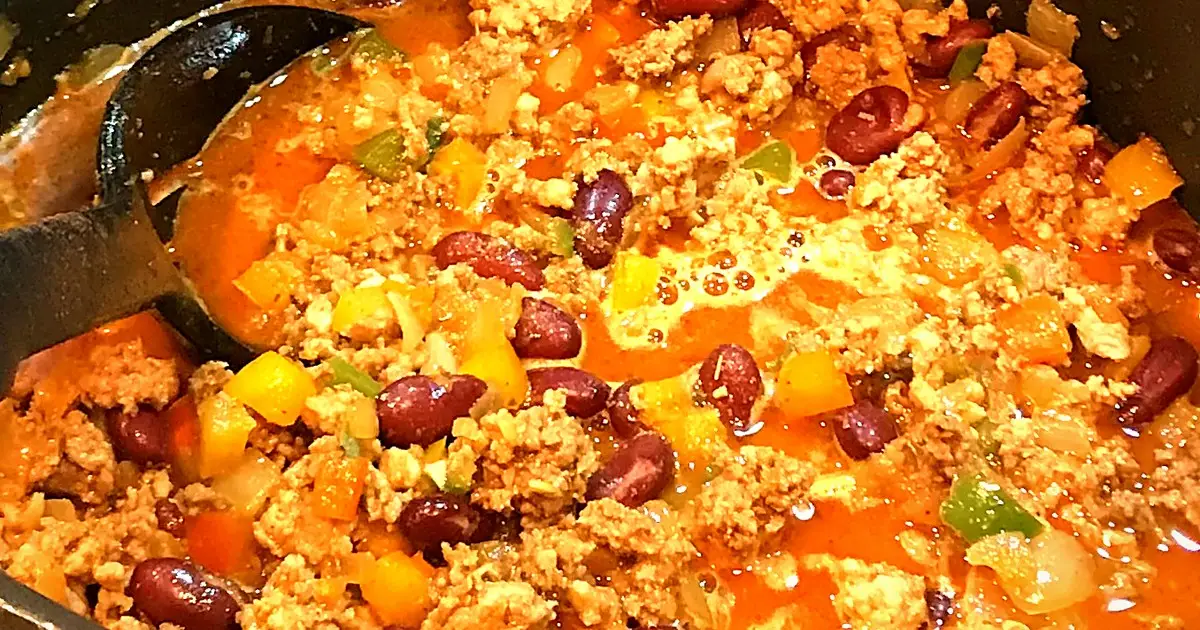
Under the hood, this is a basic Tex-Mex chili: two meats, a pile of vegetables, and one kind of bean. When you find a bean you like, you don’t take chances. Everything else is layers and a touch of Italy.
For the meat, ground beef and sweet Italian sausage, with the occasional swap for veal or pork when the mood strikes. For the veggies, Vidalia onions, a generous amount of garlic, a red, a yellow, and a green bell pepper, and a couple of jalapeños for vegetable heat. For the tomato base, San Marzanos, sweet like the Vidalias, plus tomato paste for depth. I used to cook the San Marzanos whole and let them break down over time but now I squeeze them into the pot so they break down faster. Less residual skin that way.
The beans were the key to this dish for me, and there can be no substitution: two cans of dark red kidney beans. OK maybe one substitution. I discovered I also like light red kidney beans and if you find those more to your liking, go wild. Add a can of dark beans and a can of light beans. Just don’t add navy beans.
The spices are the heart of any chili, and here’s where I do go a little wild: three chili powders (regular, ancho, and chipotle), cumin, smoked paprika, oregano, kosher salt, and cracked black pepper. Why three different types of chili powder? It isn’t chili without regular chili powder, and the other two bring different things to the party. Subtle flavor notes that make my taste buds happy.
My chili has an Italian-American accent. Sweet Italian sausage brings a whisper of fennel, San Marzanos bring the sweetness, and the Vidalias with red and yellow peppers pile on sweetness plus more layers. I use the jalapeño twice: fresh, diced into the pot, and smoked and dried as chipotle powder. Ancho adds an earthy, raisiny depth, and smoked paprika rounds it out.
The secret’s in the can
No chili is truly good without a secret ingredient. Mine is a can of beer. I used to add Boddingtons pub ale because I liked the flavor it added to the chili. I also thought the little widget that releases nitrogen and a small amount of beer at the same time into the full can of beer was cool. It does clever things to the flavor. And remember the chef’s golden rule: when you cook with beer, you have to sample it first.
Nowadays I use my favorite non-alcoholic beer, Athletic Brewing Company’s Upside Dawn, a blonde/golden ale style. It isn’t a perfect swap in terms of flavor. The Upside Dawn is brighter and lighter, but I find that the slightly spicy, citrus and herbal notes in the beer work well with the heavy spices I add to the chili. You can add whatever brand of beer you prefer, but stick with a golden or blonde ale. If you use a hoppy beer like an IPA it can turn bitter in the long simmer this recipe calls for.
Once everything’s in the pot, let it simmer. One hour gets you chili. Three hours gets you my chili. Only a quarter of the spices called for in the recipe go in up front. The rest I add a little at a time once it’s been simmering an hour, tasting as I go. That’s the part no recipe card can do for you. My palate didn’t win me over to chili, but now it’s what tells me when a pot is done. And don’t skim the fat. Fat equals flavor.
Game day
When you’re ready to cook a batch for your next tailgate, make it a day ahead. Like most chili, it’s better the second day, and it reheats beautifully in a pot on the grill. Janet’s chili was for snow days. Mine goes to football games. Garnish with lime wedges and sliced scallions and, if you want, have sour cream and shredded cheddar on the side. These days I don’t add either, but I put them out anyway. Because if I overdo the spices (which I sometimes do), those help cut the heat. Serve it with cornbread. Mine is my father’s recipe with my addition of Maryland sweet corn folded in.
If you think you don’t like chili, try it anyway. Just be sure to use kidney beans. Scoop the cream cheese and load it up with cheddar cheese if you must, but try it. For me there was the “or else” but I don’t recommend that. Give yourself an out. One bite, fairly sampled. If you don’t like it, move on to something else. But if you do, you’re welcome.