Crab Taste Challenge: Dungeness vs. Chesapeake Bay Blues
Two Crabs, Two Recipes, and Only One Winner
Two dishes, one challenge — jump straight to either recipe:
I scored some Dungeness crabs (Dungies) from my favorite online fishmongers, The Wild Alaskan Company, and after chatting with one of their staff I decided to do a two-part crab taste challenge. The first part was a head-to-head taste test to see how the flavor of the two types of crab compare. Just the meat, no spices, no dips, no sauces…and no winner. Part 1 was a draw. Part 2 would be the taste challenge where I came up with two recipes highlighting the best aspects of each crab, and there would be a winner. Janet and I held Part 2 of the challenge last week and I want to let you know how it went.
After tasting the Dungies in Part 1 there was something about the flavor and texture that screamed salad. The first idea that popped into my head was a Cobb salad…minus the hard-boiled egg. Not putting it in saves me the trouble of picking it out, which I always do. Also, no avocado…not the right texture for what I had in mind, and I was afraid the color would remind me of the green goop that inhabits the body cavity of crabs. Crustacean digestive organs are not high on my list of delicacies. I decided to snoop around online in search of something that might help me build on a basic Cobb salad with Dungeness crab as the protein and central focus.
As I browsed through hundreds of salad recipes I came across one that I thought would work. Martha Stewart of all people has a Dungeness crab and root veggie salad recipe that intrigued me. I love raw root veggies, especially in salads, though my preference in root veggies and Martha’s diverge at rutabaga so I did make some substitutions. I also came up with my own dressing…hers was running to the light, tart, citrusy side and I was going for robust.
I wish I could say that I was deliberate in selecting all of the ingredients I would ultimately use, but I’d be lying if I did. It was mainly serendipity, at least in the beginning. As I narrowed the choices down, serendipity gave way to intentionality as just those ingredients that would highlight and elevate the crab, hit one of the five senses, play well with each other, and bring a unique texture and color palate to the dish, made the cut. I was shooting for 24 ingredients and hit the mark on the nose.
Martha’s salad and a traditional Cobb salad are both very easy to prep, coming together in about 15–20 minutes. My crabby Cobb and root veggie salad took over five hours to put together, and that was after the many hours of thought I put into the concept and planning out the mis en place. It took that long mainly because I am exacting with my prep. Well, that and the fact that my knife skills suck and there was quite a bit of knife work in this dish. At least I didn’t cut myself. This time. After all that prep it took maybe 15 minutes to clean off my plate. No gluttony guilt here…it was a salad.
As I hoped, it turned out to be a robust dish with strong contrasts in texture and flavor. Some of the flavors were obvious, others snuck up on me, while still others were downright tough to isolate even knowing what I put in the dish. Red beets, basil, mint, EVOO, balsamic vinegar, watermelon radish, goat’s cheese, and the Dungeness crab all have distinctive flavors and textures that I readily picked out. Others were more subtle. The turnip and carrots for example gave up just a hint of their earthy flavors along with a welcome crispness.
One of the things I struggled with in the conceptual stage was the addition of spices. In the end I opted to stay away from any spice because though the salad was hearty, it had delicate flavors that spice would have smothered. I’m not gonna lie, since I’m from Maryland I almost tossed in a couple tablespoons of Old Bay. But the briny flavor of Dungies is so uniquely organic that I didn’t want to lose it to the overpowering salt content of Old Bay. In the end I opted for fennel.
Say what? OK fennel is not a spice, but it allowed me to add spice-like qualities to the dish without actually adding spice. I went with using both fennel fronds and crispy ribbons of fennel that I sliced from the bulb to get the full spectrum of intensity. A bite of the salad with the fronds left me with a haunting memory of a familiar citrusy flavor that I couldn’t quite put my finger on. The fennel bulb ribbons were the bomb, as in flavor bomb. Interestingly they did not leave me with an overpowering taste of anise as I feared…they actually stayed in the background enhancing, and being enhanced by, the root veggies. It was a good combination, and the flavors played together in an unexpectedly pleasant way, leaving me thinking I had added clove to the salad.
That takes me to the last ingredient I decided on for the salad, cilantro. Most people would have included cilantro on their short list from the beginning of planning the dish. Martha certainly did. Not me. It was the first thing I cut from her recipe. You can blame it on Ancestry.com. According to my Ancestry.com DNA report, I am one of THOSE people — genetically wired to have an extra sensitivity to bitter flavors, and who usually don’t care much for cilantro. As if I needed a DNA test to tell me that. I don’t like cilantro. I know I don’t like cilantro. In fact, I loathe cilantro! Where most people taste a pleasant herbal citrus, I get stink bug. So why did I include it? Well…quite simply I needed bitter and it was the easiest way to add it at the last minute. I felt comfortable with it because by this point, I had decided on a robust vinaigrette dressing that was heavy on the EVOO. Fat coats the tongue and changes the way things taste. The cilantro was a late game-day decision that I made solely in the hope that its harsh edges would be tempered by the EVOO. Thankfully, it worked.
Another ingredient I threw in at the last minute was lobster. I wanted a seafood ingredient to contrast with the crab but without overpowering it. I kept going back and forth between prawns and lobster, an East Coast–West Coast thing. The prawns I have are from Alaskan waters just like the Dungies, so I thought they would make for a poetic addition. Ultimately, I decided to hell with poetry…this was food. The texture of the lobster was a better fit with the salad than prawns would be, so I ran out to Wegman’s and picked up a lobster.
My vision for the dish delivered on all of the five senses with some of the components satisfying more than one. The goat cheese for example provided both salt and sour, the crab gave sweet and its uniquely organic brine. The red beets brought sweet, the carrots, radish, turnip, and golden beets brought umami, and the cilantro gave me bitter. All bases covered.
If I ever get my hands on Dungies again I would definitely remake this salad but there are a couple of things I would do differently. First, I would 86 the bacon crumbles. I haven’t talked about them yet, and that’s because after the first bite I picked them out. What I learned from this experience was never ever use bacon bits in a crab salad. With crab meat comes crab shell no matter how carefully you pick and sort. Anytime I bit down on something hard and unyielding I couldn’t tell whether it was bacon, in which case I was safe biting all the way through, or if it would be a tooth-breaking shard of crab shell, in which case I should back off and spit it out. I like my teeth, and I hate going to the dentist almost as much as I hate cilantro, so next time I’m leaving the bacon out.
I would also use more crab…it was the highlight of the dish and my goal was to use the other ingredients to frame the flavors of the crab. I thought I was being generous with the amount of crab I added to the salad, but I was wrong. More crab would have been more better. The final thing I would do is substitute a more earthy-tasting root veggie in place of the turnip, which tasted flaccid next to the crisp and rich earthiness of the other root veggies. Instead I think parsnip or red radish. Either one would be deliciously crisp and would add yet another note of spice to go with the fennel.
Ready to make it?
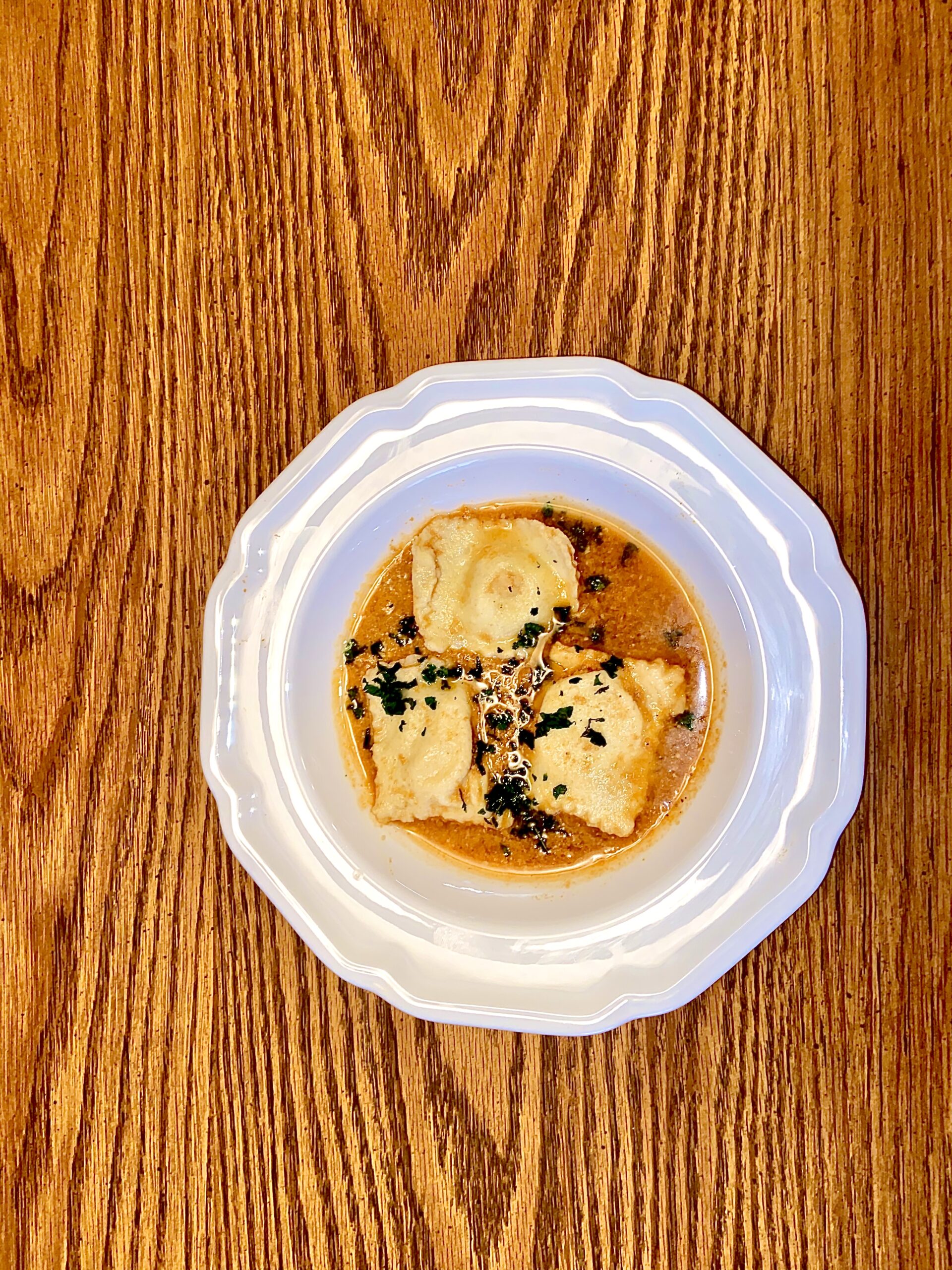
One of the things I love about food is the way smells and tastes can evoke memories. That was the direction I decided to go with my Maryland crab dish, a dish that would bring back memories, and I had a lifetime of memories eating steamed crabs to choose from. But for reasons I can’t explain, Chef Boyardee’s Beef Ravioli in Tomato Meat Sauce kept popping into my head. Probably because as a young adult on a budget it was cheap comfort food. Of course, I couldn’t do something as simple as Chef Boyardee did with his ravioli. I needed to elevate it considerably, so I turned to a real gourmet ravioli dish. The memory of this dish evokes a range of emotions for me…it was the first dish I ever ate in Brian Voltaggio’s restaurant VOLT.
I took Janet to VOLT not long after Top Chef Season 6 wrapped, where Brian was narrowly beaten out for the Top Chef title by his brother Michael. It was a delayed Christmas present and we ended up celebrating Valentine’s Day as well since it was February before I could get a reservation. I can still remember Janet’s reaction to opening the envelope that I used to put in a certificate for dining at VOLT. It was one of the few times in over three decades of marriage I was able to surprise her. Although Brian would eventually go on to become Top Chef’s only three-time loser, a distinction that still blows my mind, I had become fascinated by his unique approach to the dishes he made. His love of locally sourced ingredients, his respect for the ingredients, and his creative blending of molecular gastronomy with classic French and Italian techniques all made their mark on me. Dining at VOLT is what made a foodie out of me.
Brian’s ravioli dish featured pasta so thin you could practically read a newspaper through it. He listed it as ravioli on the menu but he actually went with a mezzaluna pasta filled with goat cheese, served in a delectable butternut squash sauce with maitake mushrooms and topped with a sage foam. Biting into one of Brian’s raviolis was like trying to eat air, it was that light.
The filling Brian used was downright decadent. Until I tasted Brian’s ravioli, I didn’t think I cared for goat cheese even though I had never tasted it. The rich yet sour and tangy sensation of the filling as it spilled out of the pasta into my mouth forever transformed my view toward goat cheese. Now THAT is a memory.
Coming up with the filling didn’t worry me too much…it would be crab of course. My biggest challenge was going to be getting the texture I was looking for in the pasta. Usually when I make pasta of any sort, I use all-purpose flour and declare victory at a 5 setting on the pasta roller. This time I knew I was going to have to go thinner…my goal was a 7 setting but ripping the pasta was going to be tough to avoid when it got that thin. I solved that problem by using a blend of equal parts semolina flour and all-purpose flour. The semolina, with its higher gluten content, gave me the extra stretch I needed to press my pasta out paper thin and still get the nice smooth texture I was hoping for.
I wanted to keep the filling simple. That was going to be where the bulk of the crab came into play, but Brian’s use of goat cheese got me thinking how yummy it would be to fold in cheese with the crab. I needed a milder, sweeter cheese than goat cheese though, to pair with the crab’s more delicate flavor. I decided to go with a blend of 2 parts ricotta to 1 part crème fraîche. I went through several iterations before I got the right mix of cheese and crab, but once I got it right the combination was to die for. In fact, after I finished laying out the pasta strips and spooning in the crab and ricotta filling, Janet asked me if she could lick the bowl I used to mix the filling.
Usually when I make filling for ravioli I add a combination of herbs and some spices. My plan for this dish was to go simple and mix the crab with copious amounts of Old Bay, some cumin and a dash of ancho chili. Yet the filling I came up with was too rich and perfect to adulterate further, so I stuck with that simple combination and passed on anything more.
For the sauce, in order to stay true to the Chef Boyardee inspiration I wanted to go with a tomato sauce. I didn’t want to lose the opportunity to infuse more crab flavor in the dish so I started by making a crab-based stock from scratch, using shells, legs, and claws left over from the crabs we picked a few days prior. In addition to the crab shell and all the Old Bay they come with, I used carrots, celery, onion, every color of bell pepper I could find, a bunch of odds and ends like peppercorns and sprigs of fresh thyme, and simmered everything for about four hours. When that was done, I removed the crab shells, ran everything through a coarse filter, then puréed it all in a food processor and poured it back into the stock pot — at which point I decreed it to have transformed from stock into a sauce. I added more veggies, whole San Marzano tomatoes, and other odds and ends like bay leaves and sautéed, caramelized shallots. I let those flavors infuse and the tomatoes break down into pulp as the sauce simmered for another four hours. I filtered it again, this time with a finer filter, and then took my immersion blender to it to smooth everything out. After bringing the sauce back to a simmer, I pulled out my cast iron skillet and, since the sauce had tomato, made up a Creole-style blond roux (butter instead of oil) to thicken the sauce.
I taste everything as I cook, adjusting seasoning and cook times based on how the flavors are turning out. Once I added the roux and got the sauce as thick as I wanted, I ran the immersion blender through it again and tasted. It was good but not quite rich enough to stand up to the ravioli filling, so I went back to the ricotta and crème fraîche, figuring it would give me the richness I wanted while helping to knit all the flavors together.
Did I hit the mark? Yes yes yes. I ended up with a dish that tasted exactly as I envisioned it would and that hit all five senses. Unlike the Dungie salad, I would make this dish again and make it exactly the same way…I wouldn’t change a thing about it. My first spoonful was a tentative sip of the sauce. It was really good. Just spicy enough to let me know Old Bay was in the game but then tempered by the ricotta and crème fraîche, which allowed the crab that infused the stock to come out. As I bit into the ravioli I got the texture and silky smoothness from the pasta I worked hard to achieve, and then the ravioli gave up its payload of crab and cheese, which mixed with the sauce in my mouth to form a rich and hearty crescendo to a very satisfying dish.
Ready to make it?
I wish I could say it was close, but it wasn’t. Both dishes were good, and I will be making both of them again. They made great use of the crab, but one was clearly better, and I can take no credit for it. It was better because the crab was better. The depth of flavors in the Dungeness crab meat allowed me to come up with a dish that delivered a complex interplay of flavors and textures. The ingredients combined to both complement and contrast with each other in the most surprising and satisfying ways. The crab ravioli in tomato sauce was also good, but the crab meat itself was unidimensional, which limited what I could do to spotlight it in a dish — even a dish with 24 ingredients on the other side of the ledger. I expected more out of it by way of the complex interplay of flavors, but I didn’t get it. That filling was truly decadent, but I took the crab as far as I could. Maryland crab just isn’t complex enough in flavor to stand up to Dungeness crab.
And the winner of the crab taste challenge, part 2, is…Dungies!