Culinary Telephone Tag
One Recipe, a Reality Show, and a Church Cookbook That Lied
Just want the dish? Skip straight to the recipe.
Get the RecipeOrigin stories fascinate me. This one starts in Odessa. It’s actually two origin stories — one for a dish and one for a family, and they came together in my kitchen. But not the way I expected they would.
Both stories start in 1870s Odessa, at the time a Black Sea port city so cosmopolitan it was practically its own country — Greek merchants, Jewish traders, Italian architects, Ottoman influences bleeding in from the south, and an aristocratic Russian class that threw dinner parties serious enough to change culinary history. It was at one of those dinner parties that a new dish made its debut.
Alexander Grigorievich Stroganov — Governor-General of Novorossia, honorary citizen of Odessa, and one of the wealthiest men in Imperial Russia — was responsible for that dish’s debut. Nothing like telegraphing the lede, but I’ll press on.
Stroganov kept what was known as an “open table” in Odessa. Any educated or decently dressed person could walk in off the street and be fed, no invitation required, forty to sixty people a day, all at his expense. Heck, I’d put on my best suit for that, and I can’t stand wearing suits since retiring from federal service.
Cooking was beneath Stroganov, so he hired a French chef, and it was that chef’s brainchild that made culinary history: small pieces of beef, fried and served in a mustard and sour cream sauce. Russian ingredients, French technique, fusion cooking before anyone called it that. Practical enough to portion for a crowd, refined enough to serve to anyone who showed up. An Odessa cookbook author liked it enough to name it after Alexander Grigorievich. Beef Stroganoff. And there it is.
The first written recipe appeared not long after the dish debuted on Stroganov’s open table, in the 1871 edition of Elena Molokhovets’s A Gift to Young Housewives — the definitive Russian cookbook of the era. It called for beef cubes dry-marinated two hours in salt and allspice (I’ll come back to that), sautéed in butter, finished with mustard and smetana, the Russian ancestor of sour cream — richer, tangier, less sharp. No onions. No mushrooms. Every version you’ve ever eaten is a variation on a variation, handed down through generations of cooks playing culinary telephone tag.
So how did I come across the original recipe? Serendipity. When I set out to make my own stroganoff, I started with the recipe Janet’s mother Gladys used. It was simple, just a few ingredients. So simple, I had to track down the original recipe to see what it was missing. Turns out it wasn’t missing anything — it was almost identical to the 1870 original. The beef, the two-hour dry marinade, mustard leading the flavor, the sour cream. No mushrooms, no pasta. It really was the original recipe, nearly verbatim. I decided to dig a little further.
I’d already done genealogy work on Janet’s family and knew she had ancestors born in Odessa, so I paused the cooking and dug out the family tree.
Marie Christina.
Janet’s great-great-grandmother, born in Odessa in 1877. Before Janet and I had kids, when we were thinking of names we might use, Janet decided if we had a girl we would name her Christina Marie after her great great grandmother. We had boys, the first named after her father and mine (Robert Allen), the second named after Marie Christina and me (Christopher Mark). When Marie Christina was eight, her family emigrated with other Odessan farm families to Hayes, Nebraska, where two generations later Janet’s mother Gladys was born. Why Nebraska? Everything about it echoed home — the flat horizon, the harsh winters, the same cash crop, Odessa’s Turkish Red Wheat, and an expat community already there to welcome them.
So there I am, looking at Gladys’s stroganoff recipe, wondering how it came to be so close to the original. For about half a minute I had a vision: Marie Christina learning the dish from her mother in Odessa, who learned it as a “young housewife” from Molokhovets’s cookbook and carried it with her to Nebraska, passing it down mother to daughter for two generations until it reached Gladys. Great story. Not what happened.
Gladys got the recipe not as a family heirloom, but from a church cookbook. Reading past the recipe to the credit line at the bottom, I found that the contributor called it “authentic,” sourced from a Navy wife who’d picked it up while living in Russia.
So much for my family-connection story.
In spite of the cookbook’s claim to authenticity, the recipe wasn’t completely authentic. It called for diced onions and to be served with rice, but the original recipe doesn’t. The church cookbook lied. Or more likely, because church cookbooks don’t lie, the recipe was the victim of culinary telephone tag. That’s how culinary telephone tag works — a recipe from a friend who got it from a friend who got it from a church cookbook, picking up a little of this and a little of that along the way.
The recipe Gladys used really did trace to Odessa. Just not through the pathway I’d imagined.
Did it matter? No. Gladys cooked a recipe popularized in Odessa at a time when her own ancestors lived there. And the real reason it didn’t matter how she got it? I was about to put that recipe through more changes in a week than it had seen in a hundred and fifty years.
My inspiration for reworking beef stroganoff was, of all things, a reality TV cooking competition. America’s Culinary Cup. I don’t like reality TV — it involves very little reality and a lot of emotional manipulation, episodes stitched together after the editors already know who did what, built to highlight whatever conflict sells. I make an exception for cooking competitions as long as they don’t involve Gordon Ramsey (can’t stand him), so I watched it. For the food. I’m still not sure the inspiration was worth the fake drama I had to sit through to get it, though I do like the way my dish turned out.
The first episode centered on Padma Lakshmi’s return to competitive cooking TV after leaving Tom Colicchio and Top Chef — this time as creator, executive producer, host, and judge. Her show, her format, total control.
Padma isn’t a chef. She didn’t go to culinary school. She’s never worked a restaurant kitchen, doesn’t know that world the way an insider like Colicchio does. Nor has she ever claimed to. But no matter how long it’s been since Tom worked in a kitchen, that’s an experience you don’t forget, and it’s an experience Padma never had. It’s what made the two of them work so well on Top Chef, but without Tom’s sense of reality to temper her new show, it offered little by way of reality.
The opening sequence had Padma arriving by helicopter, flying a thousand feet over Manhattan, landing on a skyscraper helipad, whisked away in a blacked-out SUV to a kitchen arena (that she personally designed) with floor-to-ceiling windows framing the skyline. All to sell the idea that this was filmed in Manhattan.
It wasn’t. It was a sound stage in Toronto. The Manhattan skyline showing through the windows? Not real.
The one thing that was real — the food. A genuinely talented cast making genuinely good dishes. One of those dishes, from the first episode, fired up my imagination.
The finale of that episode came down to two chefs, Phillip Tessier and Matt Peters. Both chefs were Bocuse d’Or medalists — the closest thing the culinary world has to Olympic medalists. If you’ve ever seen footage of the actual event, chefs are treated with as much national-flag-waving fervor as Olympic athletes. Phillip took silver in 2015; Matt took gold in 2017, coached to it by Phillip himself. Which meant Matt was now the chef who would eliminate his own mentor from the show. Made-for-TV drama. Or should I say made-up for TV drama.
You’d expect such a level of talent in the first episode’s final cook-off, where only one of the two chefs survives to cook again, would promise an even deeper bench for the rest of the season. It didn’t — the other chefs were good, but not Bocuse-d’Or good.
The elimination challenge: make an elevated version of one of the most familiar dishes in America, beef stroganoff. In one hour. Both chefs delivered dishes worthy of their medals. Phillip’s, by every judge’s admission — Padma included — was so complex they couldn’t believe he’d pulled it off in an hour. She called it a 10. Last I knew, in Olympic scoring a 10 means perfection. The two guest judges split their votes, of course, one voting for Matt to stay and the other for Phillip. That left Padma to cast the deciding vote. She sent Phillip packing, though she did so with much anguish at having to cast the deciding vote with two dishes so close in quality.
Spare me. Phillip didn’t lose on merit. He lost on format. Her format. Her rules. Her show.
Time I’ll never get back, but I did walk away with a concept.
Phillip’s dish leaned on technique I knew I couldn’t touch, plus truffles. I don’t like truffles. Matt’s dish was the one that appealed to me — he’d taken an embarrassingly simple dish (small pieces of beef in a mustard-and-sour-cream sauce, portioned for a crowd) and elevated it into something you’d willingly pay for at a high-end restaurant yet at the same time managed to keep it rustic. That’s culinary art, and that’s the dish I wanted to make. Probably not as well as Matt did, but if I even came close, I’d be satisfied.
I won’t do a blow-by-blow of everything Matt did or everything I did to reverse-engineer it — you can infer most of it from the recipe. A few highlights, though.
First, the beef.
The original recipe’s dry rub of salt and allspice, left on for two hours, is exactly right by modern food science — for the salt. Salt is the only seasoning small enough to cross into the muscle tissue through osmosis; anything else, allspice included, is too big at a molecular level to get past the cellular gatekeeper. It ends up just sitting on the surface, waving bye to the salt as it heads inside without it. I know this from Alton Brown’s Good Eats. I’ve also confirmed it myself with a Thanksgiving turkey brine full of aromatics that made my kitchen smell like Thanksgiving, but did nothing for the flavor of my bird. And just last week on a NY strip steak I tried the same salt-and-allspice rub the original beef stroganoff recipe called for. I didn’t set out to ruin the steak, it was our dinner not a taste test. I just wanted to prove to myself that allspice in the rub would behave as I expected, which it did. In Janet’s words, it made the steak taste like Thanksgiving. That’s it. That’s the whole effect — surface seasoning, not the layered depth chefs like to claim.
So why did the original recipe call for it? I promised to come back to it, so here it is. To beat the funk. What passed for refrigeration at the time, an ice chest, wouldn’t have kept out the funk that crept in during the time between slaughter and the pan.
The allspice wasn’t used to season the meat for flavor. It was used to mask the off odors and flavors the beef picked up. I have no idea if Matt used a rub — he’d have had just enough time in the hour, so he probably did — but I’m confident he skipped the allspice. Because if he’d used it, he’d have been the one going home.
Matt built his dish around rib cap, the most tender and flavorful part of a rib eye. I used tenderloin instead — even more tender but with less fat, less flavor — I made up that difference elsewhere.
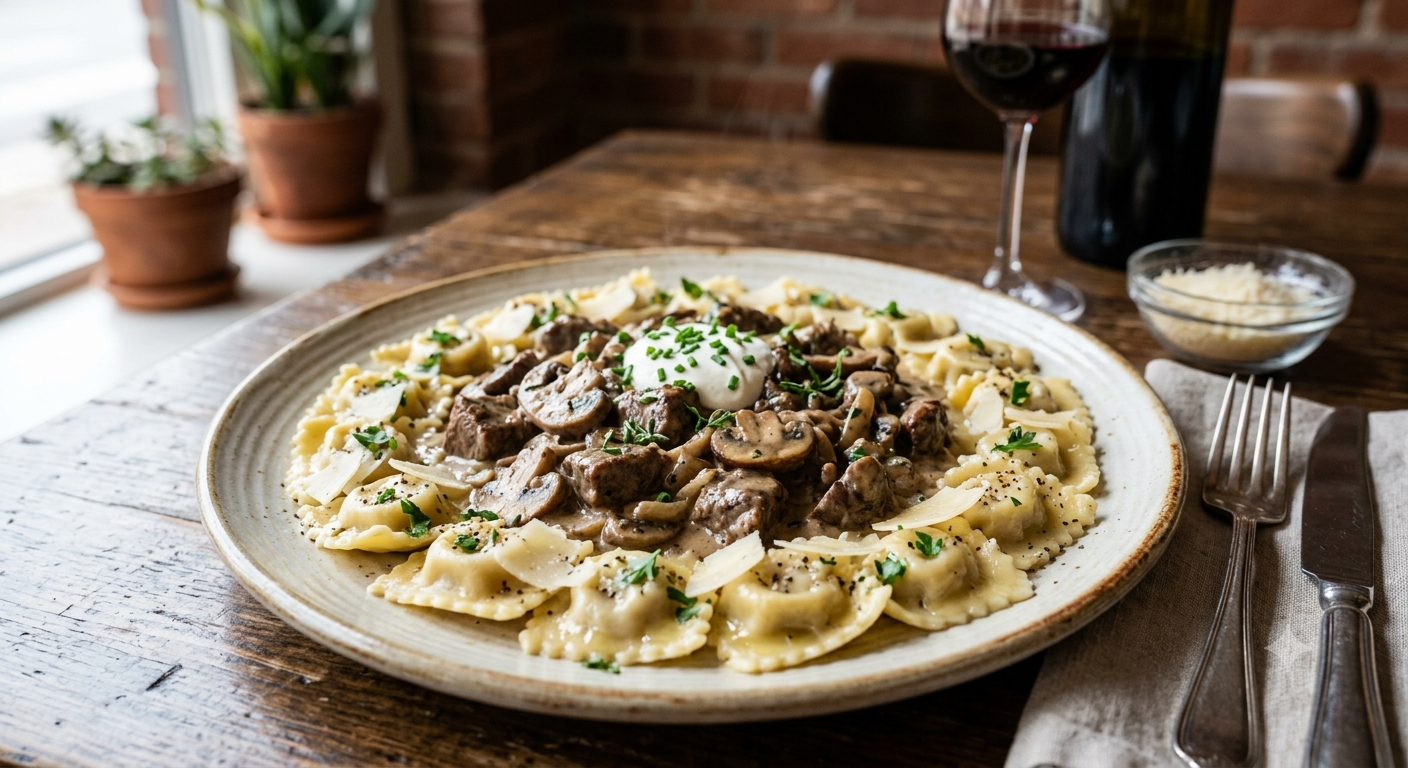
The original Odessa version was served with nothing but bread. Gladys’s version kept that austerity, though she paired it with rice instead of bread. More culinary telephone tag. Matt made pasta for his dish. Only, it wasn’t something as simple as noodles. That would be too easy for a Bocuse d’Or gold medalist. He made agnolotti — mini raviolis pinched apart rather than cut, giving them the look of little pillows. So I did as well.
I’ve attempted ravioli plenty of times, with mixed results. I can make the dough and roll it out just fine, though not in under an hour. My problem is that I’ve never solved the challenge of sealing the top pasta sheet over the filling on the bottom sheet without air pockets that blow the seams in the pot. When I set out to recreate Matt’s dish, a few YouTube videos on agnolotti technique solved that problem for me — it’s now my favorite filled pasta, to the point that I fake my “ravioli” by scoring already-sealed agnolotti with a pizza cutter. Closet ravioli.
I didn’t know what Matt filled his pasta with until I rewatched the episode and caught the clue I’d missed — mushrooms, folded into his cream sauce. I went another direction: ricotta, wilted spinach, Parmesan with lemon zest, an egg yolk, whatever herbs I had, and an eighth of a teaspoon of nutmeg. Mushrooms were in my sauce, not in the filling. One thing carried over without any reverse-engineering at all: onions. Gladys already had that right — her one improvement on the original — and I wasn’t about to undo it.
What the nutmeg did for my dish was a surprise. It became a flavor substitute for the allspice I didn’t use in the beef dry rub. It’s not related to allspice — different plant families entirely — but they share eugenol, the aromatic compound behind that warm, clove-like note in both, which is close enough that swapping one for the other worked. Adding it to the filling replaced what I’d lost by cutting allspice from the beef, but without the Thanksgiving flashback. Same aromatic tension, different direction, more refined and more layered. I’d love to take credit for the idea, but it was an accident.
The Parmesan I used in the filling did something similar. The original sauce used smetana, not the sour cream I used — heavier, tangier, closer to yogurt. I got the richness back with heavy cream in the sauce, and I got the tang back from the Parmesan I used in the filling — not a straight substitution, but the same flavor profile arriving from a different angle. It didn’t replace the sour cream, it augmented it.
The sauce itself was the hardest part to reverse-engineer. My only clue was Padma calling it creamy and “unctuous” — a word that’s an insult in every context except a food judge’s mouth, where it’s high praise. Her comment told me to add heavy cream, but it didn’t tell me much else.
The original recipe leans on mustard as the sauce’s main flavor, for the same funk masking reason as the allspice. I used one teaspoon of Dijon, in honor of Stroganov’s French chef, enough for depth without letting it carry the dish. I didn’t need to mask the flavor of my beef, I wanted to showcase it.
My one addition with no historical claim at all: a teaspoon of Worcestershire sauce. Lea & Perrins was selling it commercially as early as 1837, so it would have been period-authentic. Stroganov’s chef just never used it, likely too English an ingredient for a French chef cooking for an Imperial Russian aristocrat’s table. The genius of Worcestershire is that, used with restraint, it doesn’t announce itself; it just intensifies the umami already in the beef stock and pan drippings. Like liquid MSG without the stigma. It’s my secret weapon for making up the beef flavor I lose by using tenderloin instead of rib cap. Best of both worlds, flavor and texture.
I started with a recipe that traces to 1870 Odessa — not through the family connection that would have made the better story, but the way recipes usually travel: word of mouth, swapped and changed along the way and eventually printed in a church cookbook. Culinary telephone tag. I started closer to the original than most people ever do, borrowed from a culinary award winning chef’s version, and then put my own changes on it.
Tag. You’re it.
Get the Recipe