Even a Culinary Snob Needs a Weeknight Win
Thirty Minutes, One Skillet, Zero Apologies
Just want the dish? Skip straight to the recipe.
Get the RecipeI have a confession to make. I am a snob. A culinary snob. If you know me, that isn’t news — my kitchen looks like Williams-Sonoma and Sur La Table had a love child. All-Clad cookware, a Le Creuset Dutch oven, a Sous Vide Supreme cooker, a molecular gastronomy spherificator (I love that thing), and a collection of Japanese knives I’ve been curating like fine art for several years. All Christmas gifts from Janet and the kids. Those blades are wicked sharp, which may be why I nearly amputate a finger every time I get distracted while dicing garlic.
But here’s the thing: even snobbery needs an occasional night off. Sometimes you stumble across a recipe so unpretentious, so ridiculously simple, yet so packed with flavor that you willingly set aside the advanced culinary expectations and just…cook. That’s what happened when I discovered huli huli chicken and made it my own — a dish that goes from prep to table in 30 minutes, requires nothing fancier than a skillet and stirring spoon, and tastes like you’ve achieved culinary nirvana. Best of all, it didn’t involve the local fire department, unlike some of my prior kitchen experiments.
Naturally, I had to know the origin of this amazing dish. Because it’s what I do. Huli huli chicken was invented in 1955 by Ernest Morgado, a Honolulu businessman who ran the Pacific Poultry Company and needed to serve something memorable at a meeting of local chicken farmers. (The irony was not lost on him.) He landed on a teriyaki-style marinade adapted from a family recipe, scaled it up to meet his needs, and created culinary history.
The dish gets its name from the cooking method, grilled over a bed of kiawe wood coals. “Huli” means “turn” in Hawaiian, and Morgado’s grill-masters would yell “Huli, huli!” to remind their crews to keep rotating the chickens for even cooking and maximum glaze coverage. Morgado kept the original recipe secret until he died, which means every huli huli chicken you’ll eat today is someone’s interpretation. Mine included.
Where Morgado’s grill crews managed half a dozen or more whole, spatchcocked chickens over a kiawe wood fire, my version works with one chicken (or just a couple of butterflied thighs) in a skillet. I use a sauce rather than a glaze, and while nothing perfectly replicates the smoky notes from kiawe wood, a splash of kiawe wood liquid smoke (Amazon.com to the rescue) comes pretty close. I call my version huli skillet chicken. Because I cook it in a skillet. And it only gets one huli.
Before I go further, a quick confession: when I say “my” version, I mean the one I took off the internet and adapted to suit my needs. I discovered huli huli chicken the way most culinary revelations happen — by accident.
We eat a lot of chicken…three or four times per week. When we aren’t eating chicken it’s fish, so I’m constantly looking for new recipes. And there are days when I don’t have the luxury of time, patience, or energy to do the full production. So, I like to have a few quick prep meals in my arsenal.
It was years ago during a work trip to Oahu (for my first career). If you’ve been to any of the Hawaiian Islands you know that roadside grills and shrimp trucks are a thing. Being a culinary snob, I don’t make it a habit to grab food from a rusted-out shrimp truck or roadside grill. Unless I’m in Jamaica. Because roadside grills are the only place to get a proper jerk chicken.
On this trip I was driving back to my hotel on Waikiki Beach from a day of meetings in the Waipahu area and decided to take a short cut via the North Shore. OK, not a short cut. About as far away from a short cut as you get on an island. But every time I visit Oahu I make it a point to hit the North Shore. By the time I got there I was hungry. I couldn’t help myself when I caught a whiff of glazed chicken mixing with the smoke from kiawe wood coals. I pulled into what passed for a parking lot, a wider portion of the shoulder, and caved in to my hunger. I’m glad I did. That chicken was lip smacking good.
Years later, when I stumbled on a copycat huli huli recipe online, I recognized it immediately. I had to make that chicken. But not without putting my personal touches on it.
My huli skillet chicken is the rare dish that comes together fast and tastes like it takes a Herculean effort to make, without taking a Herculean effort to make. It hits every flavor note — sweet, salty, tangy, with that ineffable umami quality that makes your taste buds stand up and salute. The flavor complexity makes you look like a culinary genius that spent hours in the kitchen, when it actually takes roughly the same skill level, and only slightly more time, than making a peanut butter and jelly sandwich.
When I found the recipe it was for a teriyaki style marinade and glaze meant for chicken cooked on a grill. I like cooking on my grill. My culinary obsession extends to my patio where I have a high-end Weber gas grill. Even though I’m cooking for just me and Janet most of the time, I can fit two whole chickens on that thing. Three if they’re spatchcocked. But cooking chicken on a grill takes time and constant attention, both to the grill temperature, which is notoriously hard to regulate even on a Weber, and to the meat. That’s where the huli huli comes in, but I wasn’t looking for huli huli. I’d settle for huli.
I adapted the recipe so I could cook it up in a skillet, and subsequently tried it in a Dutch oven and my InstantPot. All three work beautifully, though if I’m being honest I prefer the Dutch oven version. The skillet is what I started cooking it in, but after making it a few times one of the tweaks I made was to take the noodles and veggies I serve with it and stir them in with the chicken and sauce. The first time I tried that with my All-Clad skillet, whooo, what a mess.
What makes this dish work as a quick but flavorful meal is that most of the prep is passive. The marinade doubles as the sauce and it comes together in minutes — just whisk together soy sauce (I use low sodium), brown sugar, ketchup (yes, ketchup…don’t judge), rice vinegar, pineapple juice, ginger, and fresh garlic. You can make it days in advance and keep it in the fridge.
Here’s the only planning required: divide the marinade between two containers. One for marinating the chicken, one reserved for the sauce. And if you like extra sauce, double the recipe and put the extra in the reserved container. Toss the chicken into its container before you leave for work, or at lunch time if you work from home as I do. By the time you get home it’ll be tenderized and ready for the skillet.
Start half an hour before you want to eat. Fair warning: while the active prep and cook time is short, you’ll actually be doing things — this isn’t a “set it and forget it” situation. But neither does it require a huli huli level of attention.
I put water on to boil for noodles, pop some mixed veggies in the InstantPot to steam, then preheat a skillet over high heat. Once it’s screaming hot, I add the chicken thighs and sear them 3–4 minutes per side. While they’re searing, I also prep two extras: I slice a red bell pepper into strips and dice a few pineapple rings into chunks. Less is better when it comes to the pineapple as it adds sweetness to the dish that can overpower everything else if you add too much. I know because I’ve done that. And if you are feeling particularly unmotivated for prep work, you can get by with using canned crushed pineapple. The dish works fine without the extra ingredients, but it’s better with them.
After searing, I add the peppers and pineapple to the skillet and pour in the reserved marinade. I like extra sauce, so I also pour in the marinade the chicken steeped in. Yes, the same marinade. Before you panic: the USDA says reused marinade is fine as long as you bring it to a full boil to kill off any bacteria transferred from the raw chicken. I’m not a food scientist. I’m a guy with a skillet and a thermometer. So I play it by the book. I keep the heat cranked up, bring the whole skillet to a rolling boil for a minute or two, then drop it back to a low simmer. If you’re immune compromised, or just grossed out at the idea, dump the steeping marinade down the drain and use only the reserved portion. You’ll end up with less sauce, but the flavors will all be there.
After the sauce calms down to a simmer add the chicken back in, cover, and let it go 10–15 minutes until the chicken hits 170–175 degrees. USDA says 165 is safe, but thighs taste better when the connective tissue has had time to render even a little bit.
While the sauce and chicken are cooking and the marinade is cooking off its bad intentions, I turn my attention to the noodles and veggies. I cook the noodles al dente, drain them, and set them aside. I steam the veggies until they’re just barely cooked, then shock them in ice water to stop the cooking and preserve the color and set them aside as well. The shocking part is also optional.
When the sauce and chicken are done, I remove the chicken and stir in a cornstarch slurry. That isn’t necessary but I prefer a thicker sauce, the better to stick to the noodles. Once the sauce has the consistency I’m looking for, I add the noodles and veggies and let them reheat and absorb some of the delicious sauce.
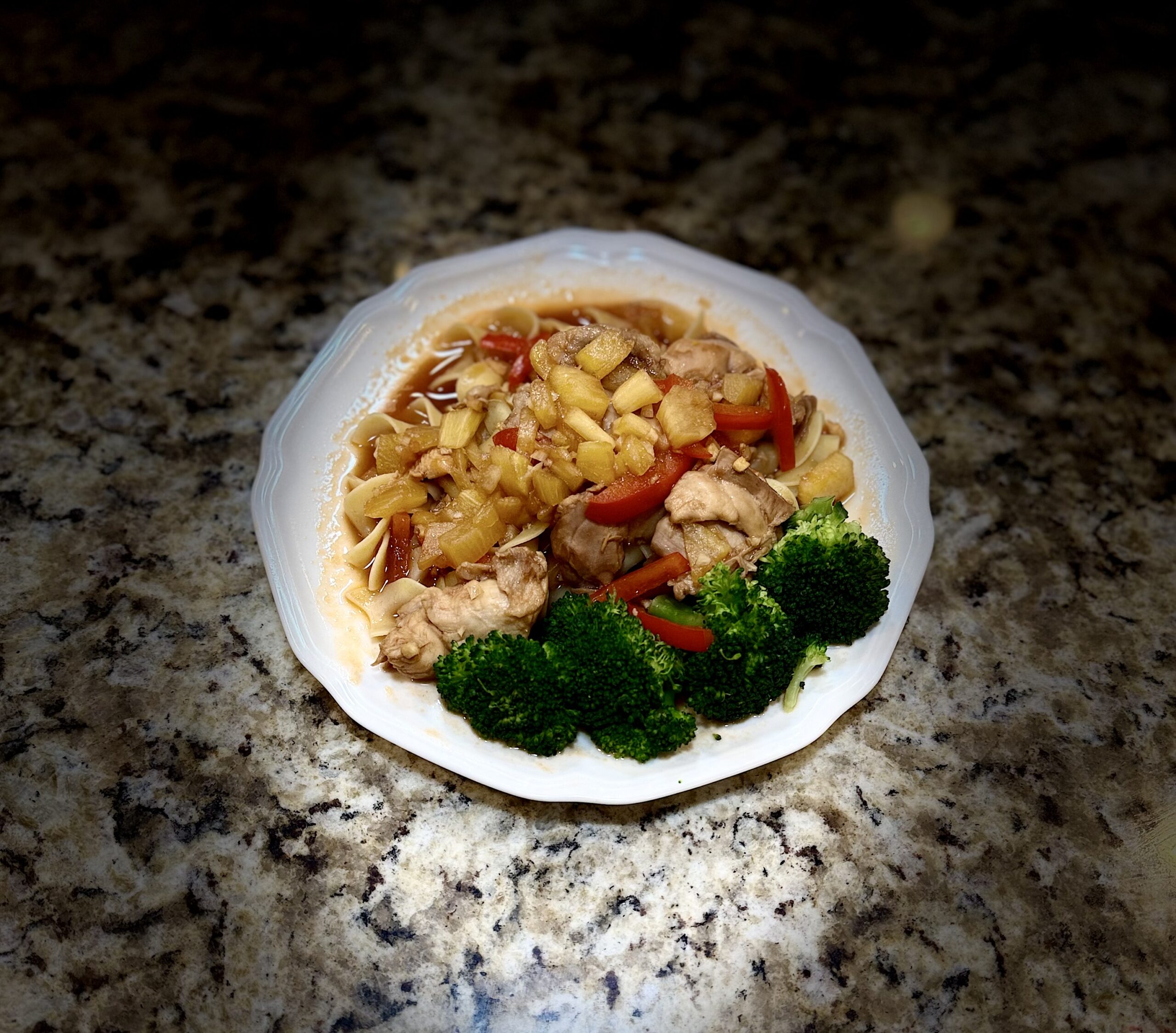
I plate it simple: noodles in the middle, chicken thigh and veggies alongside, sauce over everything. Or when I use the Dutch oven and add the noodles and veggies in with the rest of it, one big pile of noodles, sauce and veggies in the middle of my plate with a chicken thigh on top. The result? A complete one-pot meal that tastes like you tried much harder than you did. OK, technically it’s three pots if you count the pasta pot and the InstantPot for the veggies.
I understand the appeal of culinary complexity — it sucked me in years ago and I’ve spent a small fortune on equipment that will outlive me. But sometimes the most sophisticated thing you can do is recognize when simple is smarter. Huli skillet chicken won’t impress your spherificator, but it will keep you from ordering out on a Wednesday night when you’re too tired to think. And the recipe scales so you can make a double batch. The leftovers are even better the second time around and make for a great next-day lunch.
So yes, I’m a card-carrying culinary snob with strong opinions and expensive knives. But even snobs need weeknight wins. Huli skillet chicken? Pizza delivery’s worst nightmare. And if I’m being honest? This thirty-minute dish has earned a permanent spot in my rotation, right alongside all those recipes that require equipment most people don’t own.
That should tell you everything you need to know.
Get the Recipe