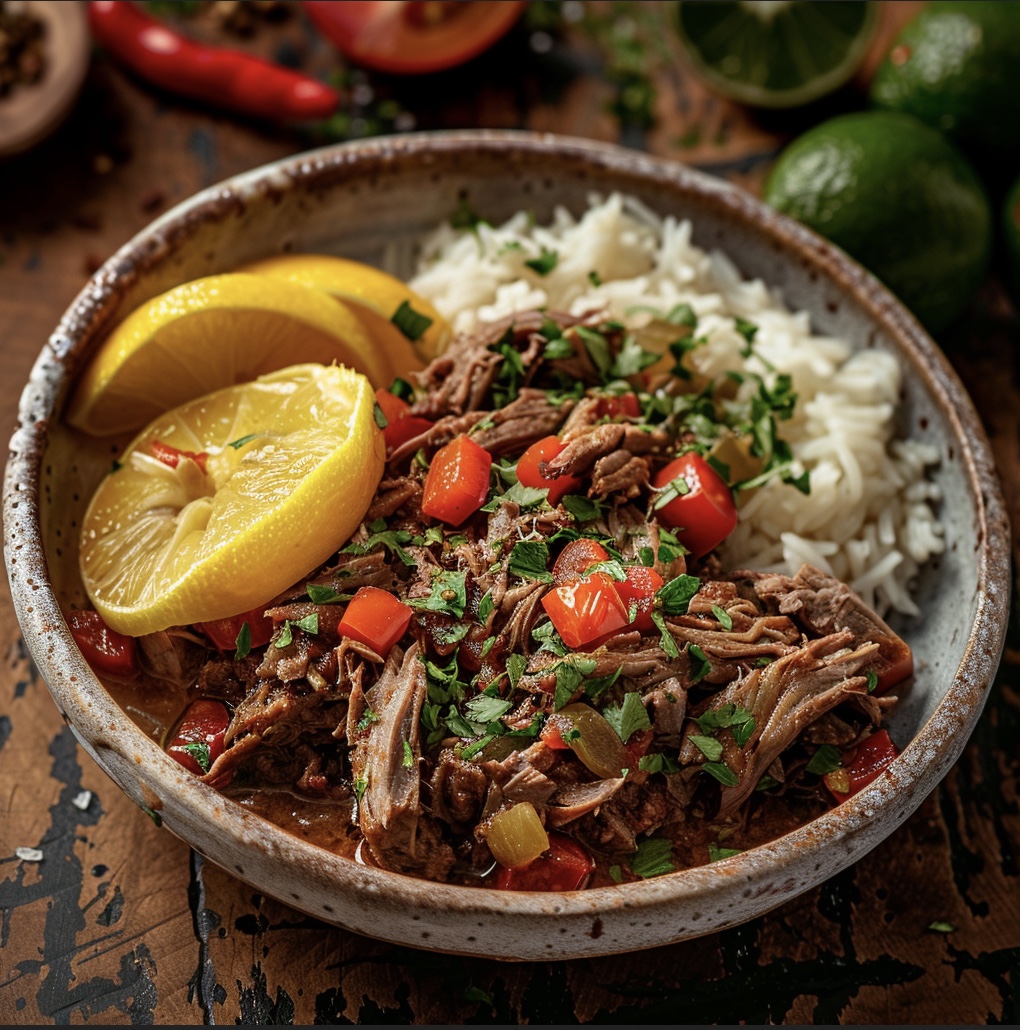
The Mystery in the Meat: Cuba’s Ropa Vieja and Why It Tastes Different Every Time
Seven Centuries, Three Eras, and a Dead End Involving a TV Show About Murder
Just want the dish? Skip straight to the recipe.
Get the RecipeI like to eat like a local when I travel. Occasionally I encounter something that appeals to my palate so much I try to recreate it at home. I usually fail miserably. Once so miserably I ended up with three fire trucks in front of the house. As frustrating as my kitchen failures are — for me and for the local fire department — they tend to sharpen my appreciation for what professional cooks do. And every now and then, I get it right.
This is one of those times. But it took seven years, a dead end involving a TV show about murder, and a history lesson about Fidel Castro’s beef policy to get there. And the Le Creuset Dutch oven Janet gave me for Christmas last year.
Janet and I visited Cuba in 2019. I had a lamb stew at a Havana café that I promptly forgot about because I don’t love lamb. It wasn’t bad. It just wasn’t memorable. I filed it away and moved on.
Fast forward to last year. I was searching for a recipe inspired by the TV show Bones — long story, involves hot sauce, my son Rob, and a mystery meat recipe challenge that got out of hand. I found a Bones episode literally titled “The Mystery in the Meat.” Perfect, I thought. Until I watched it. The episode involved a food scientist whose remains ended up in a school cafeteria meat grinder. Ew. Gross. Moving on.
Digging further, I found a different episode — one where a Cuban immigrant describes a dish his grandfather used to make back in Havana. Ropa Vieja. Beef cooked so long it fell off the bones. That sent me down a research rabbit hole, and somewhere in the middle of it I realized: that forgettable lamb stew in Havana wasn’t lamb stew at all. It was Ropa Vieja, made with lamb instead of beef. The mystery in the meat.
Ropa Vieja originated between the 14th and 15th centuries on the Iberian Peninsula. Sephardic Jews developed it as a way to serve a flavorful meal without violating the prohibition against cooking on the Sabbath — a simple beef stew with sofrito, tomatoes, and whatever produce was on hand. The beef was cooked the day before, left to tenderize overnight, then shredded and warmed in a sofrito and crushed tomatoes on the Sabbath.
Spanish immigrants from the Canary Islands brought the dish to Cuba in the mid-19th century, where it was adapted to local ingredients — New World peppers (think sweet, not hot) found their way in and the dish was simplified considerably. It caught on fast and soon became Cuba’s unofficial national dish.
Then Castro happened.
When Janet and I visited Cuba, locals told us that before the revolution, Cuba had more cattle than people. In 1963 Hurricane Flora decimated Cuba’s cattle herds, and under Castro’s nationalized agricultural “husbandry” there was no recovery. His solution: make it illegal to sell or serve beef to anyone but the government elite and tourists. That law stood for nearly six decades. The issue was more complicated and nuanced of course, but that’s how it affected Ropa Vieja.
Cuban cooks adapted — as Cuban cooks always have — and started making Ropa Vieja with pork and lamb. Which explains the lamb stew I had in Havana in 2019, and why I didn’t recognize it for what it was.
Finding the right recipe wasn’t simple. The earliest results from my searches were from Castro-era paladares — the family-run private restaurants that operated as black-market enterprises under Fidel and were legalized under Raúl. When I finally tracked down some pre-Castro recipes, they raised as many questions as they answered. Then came the Miami versions — recipes from ex-pat Cuban restaurants claiming generations-old family authenticity, but with ingredients that didn’t match what I’d expected.
Eventually I understood: there is no single recipe for Cuba’s unofficial national dish. The differences aren’t so much about culinary choices as they are a record of what was available at any given time.
So I decided to cook all three eras at once.
I tested a pre-Castro version and a post-revolution paladar version side by side. The pre-Castro was better, and not by a little.
The Miami ex-pat recipes kept pulling at me — professional chefs cooking without constraints, choosing the best of everything. In the end I combined the best of all three: the pre-Castro sofrito base and tomato sauce; the post-revolution emphasis on tomato paste and a heavier onion-garlic foundation; and from Miami, modern cuts of beef along with the red bell peppers and pimentos.
The result was the best beef stew I have ever tasted. No false modesty.
The Miami recipes also changed how I cook the beef. Traditional Ropa Vieja calls for boiling the beef, then finishing it in the sofrito — a method rooted in the original Jewish Sabbath restrictions. The Miami chefs skipped all that and braised the beef directly in the stew, which works better in a busy restaurant kitchen and, it turns out, produces a richer dish. All that rendered fat and sinew stays in the pot instead of going down the drain with the boiling water.
I split the difference. I braised the beef in the stew — but over six hours at 250°, not the two or three hours a restaurant would use. Slow enough to simulate the old overnight tenderizing method, and long enough to fully gelatinize the fat and connective tissue into that silky, unctuous texture you cannot get any other way. The Le Creuset handles this beautifully.
Ropa Vieja is traditionally made with flank steak. The cut’s long muscle fibers are what give the finished dish its characteristic ropy appearance. I use skirt steak. It’s also a long-fiber muscle, but the fibers are shorter and coarser than flank, which does affect the rope-like look of the finished dish. The trade-off is worth it. Skirt steak carries more intramuscular fat and connective tissue — exactly what you want in a six-hour braise. You still get the ropy appearance. You also get that rich, silky depth of flavor that only comes from rendering skirt steak’s fat and sinew over six hours.
I skip the chickpeas called for in the earliest Iberian versions — a 14th-century leftover-repurposing move that I feel no particular obligation to honor — and the olives, added when the dish arrived in Cuba. Leaving out the chickpeas was not a difficult decision. I hate chickpeas. I hate the flavor, I hate the texture, and I hate that so many people love them. I like olives, but they felt out of place in the dish I was building. In a small nod to tradition, I sear the skirt steak in olive oil before braising.
For the wine, I don’t drink, and I know that alcohol does not fully cook out of a braise regardless of what the cooking shows say. I developed my own substitute — unsweetened organic grape juice, apple cider vinegar, and beef bone broth in a ratio I’ll include in the recipe notes. It makes the finished dish richer than wine does.
I kept it classic for herbs and spices: oregano, cumin, salt, black pepper, paprika, and bay leaves. OK, so the oregano isn’t a classic Ropa Vieja ingredient, but it is an ancient herb that was commonly used in 14th and 15th century cooking so why not? Plus it makes the recipe mine.
My sofrito is heavy on onion and garlic, with diced red, yellow, and orange bell peppers, plus rough chopped pimento peppers. I reserve some of the green and red bell peppers and cut them into matchsticks, adding them partway through the cook — those add to the finished dish’s characteristic shredded, ropy appearance.
Six hours in a Dutch oven at 250° renders the maximum amount of fat and sinew from the skirt steak and gelatinizes it into a smooth, silky stew that feels as good in the mouth as it tastes. A few months of research and half a dozen test cooks to get there. Worth every one of them.
Make it with skirt steak if you can get it. Trust the cook time — it takes that long. And if anyone suggests lamb, smile politely and change the subject.
Get the Recipe