What happened when our Rhine cruise met Europe’s worst drought in decades — and how the top five river cruise lines responded
Note: Written August 2026, during the Rhine/Danube low-water crisis
When Janet works with first-time river cruisers, they eventually get around to asking the one question all of them seem to have: what happens when the rivers are too low? Having just experienced two river cruises during one of the driest summers in European history — resulting in the lowest water levels in key rivers like the Rhine and the Danube — I can tell you a thing or two about how the cruise lines handle matters when the rivers dry up.
River cruises can be disrupted by high water levels or low water levels. High levels result from spring thaws and rains, when runoff floods the rivers. And of course, low levels result from the increasingly prevalent summer drought conditions, compounded by higher evaporation levels due to higher temperatures. River cruise lines follow a similar script anytime cruising on the rivers is disrupted, and if a river cruise is in your future, it helps to know what to expect.
Each line has its own approach to dealing with water level problems. It can be a deciding factor in future years when selecting one cruise line over another, and even one river over another.
Low water on Europe’s busiest rivers is not a new problem — the earliest documented marker of a severe European drought dates to 1417, on the Elbe. What’s new is the frequency: conditions that used to occur once or twice in a lifetime have now hit in 2003, 2018, 2022, and again in 2026.
The 2018 drought was the first time in living memory that Rhine boat traffic ground to a complete halt; this summer it happened again, with water levels at the key gauge point falling to the lowest since records began in 1880. The Danube fared even worse, with low water beginning in late July and persisting until significant rains fell in late August.
Modern river cruise ships are built with flat, shallow bottoms — a draft of about five feet on the newest ships — to move through all but the lowest river levels. The greatest risk is an uncharted sandbar that can ground a ship before anyone knows what happened, and this summer tested every line sailing the Rhine and Danube.
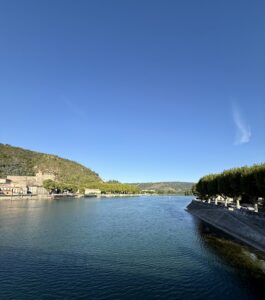
Our trip featured two separate river cruises, one on the Rhone River in France, and the other on the Rhine River. The difference between the two experiences was striking. Our cruise on the Rhone was completely unaffected, whereas our cruise on the Rhine was disrupted.
The Rhône can remain sailable when both the Rhine and Danube are not because the river was deliberately engineered with a chain of dams and locks that maintain consistent depths across most of its length. Neither the Rhine nor the Danube has such an end-to-end system of water control, and neither is likely to anytime soon. A complex blending of hydrology, geology, human engineering limitations, and scale renders it impractical (if not impossible). River cruise disruptions, particularly during periods of drought but also when water levels run high, will continue to be something the cruise lines will have to live with. That does not mean you should avoid a river cruise either during the spring flood season or the summer drought months, but you should have reasonable expectations for the experience, and how the cruise lines handle disruptions.
What Does a River Cruise Line Do When it Can’t Cruise the Rivers?
Things came to a head this summer when a Viking River cruise ship ran aground on the Danube River in Bulgaria, forcing evacuation of the passengers and crew. Another river cruise ship ran aground on the Rhine River near Bonn and had to be pulled free by a freighter. After those instances, river cruise lines shifted to a combination of cancelling cruises or rerouting their passengers over land to avoid the portions of the rivers that ships couldn’t pass through.
Cruise lines have four ways to deal with low- or high-water disruptions: the cancelation, the land tour, the ship swap, and the combo plan. We had the combo plan for our Rhine River cruise with both a ship swap and a land tour component.
The ship swap is the most interesting approach for getting beyond unnavigable portions of a river, and I want to spend a little bit of time addressing it.
The Ship Swap Defined
The major river cruise lines have multiple ships operating on the same river, usually one or more ships cruising upriver while at the same time one or more ships are cruising down river. If there is a portion of the river that is unnavigable, ships moving in both directions stop short on their respective sides of the unnavigable portion. Passengers are transferred by motor coach around the blocked area from a ship on one side of the blockage to a different ship on the other side of the blockage. Usually, the only inconvenience is passengers have to pack their luggage and leave it outside of their staterooms the morning of the swap so it can be transported by the crew to their new ship.
River cruise ships sailing the same river are nearly identical in design. What makes a ship swap work so smoothly when you change ships, is that you don’t change staterooms. Stateroom 316 on one ship is in the same place, and is the same size and configuration as Stateroom 316 on every other ship the cruise line operates on that river.
Guests head out in the morning for previously planned tours, and in the afternoon instead of returning to the ship they started the day aboard, they get dropped off at a ship past the unnavigable portion of the river.
Passengers on the new ship they board likewise will have left their ship that same morning, and after their day’s tours were transported to the ship positioned on the opposite side of the unnavigable portion. The only way any guests know they are on a different ship is the name on the hull, any difference in carpet pattern or color, and the crew members (passengers and the cruise director swap ships, crews remain).
How did it work this year?
Each line has a contract with passengers that lays out what they are obligated to do in the event river levels impact navigability. But that’s just the legal minimum. It is more useful to track what the cruise lines did operationally. Some stuck to their minimal contractual obligations while others went well beyond what they were required to do for their passengers. I’ll lay it all out for each of the five top river cruise lines in Europe, listed in order of their generosity toward their passengers.
Avalon Waterways — least generous on paper, one of the two most generous in reality
Avalon is Janet’s preferred river cruise line for a number of reasons, but how they treat their passengers when things don’t go according to plan is one of the most important. On paper, Avalon’s contract gives them the legal room to do the least of any of the top five river cruise lines — full discretion, no guaranteed refund, no compensation for inconvenience. But that’s a liability shield, not a description of intent, and their operational choices this year were among the most generous of all river cruise lines. Both of our cruises this summer were with Avalon so I can speak to our personal experience, not just the Facebook version.
Avalon cancelled just two cruises outright and offered guests 100% refunds of all money paid. For cruises with modified sailings, Avalon offered guests the option to cancel with full refund (not a credit, but actual money back to original form of payment). For guests who chose to continue with those modified cruise itineraries, Avalon offered an unprompted partial refund. All of this even though guests were well beyond the full penalty phase when Avalon informed them of the disruption to their cruise. That’s a stronger outcome than what either Viking or AmaWaterways delivered as I’ll cover in a minute.
I won’t get into the mechanics of how Avalon managed our interruption except to say Avalon Waterways is a member of the Globus family of brands. That makes them uniquely able among river cruise lines to adjust from river to land when required. They made the best of an unfortunate situation and handled all the logistics exceptionally well. Their standing 2026 policy also builds in a specific trigger of its own: if a disruption isn’t resolved within 48 hours, guests are automatically transferred to a sister ship — the same kind of built-in guarantee Scenic has, just aimed at keeping the cruise moving rather than keeping money in the corporate coffers.
For our cruise, a modified-but-not-cancelled sailing, the operational disruption consisted of two days of land touring, one night in a luxury hotel, and a ship swap that allowed us to complete all but one day the cruise we booked. For the inconvenience of the disruption, we received a 25% refund of our cruise fare. That’s a true refund, not a future credit with strings attached.
As far as the specific changes, Avalon managed to salvage most of our original itinerary, albeit by making use of motor coach transport for two full days. We spent one day with land touring in Heidelberg, the second day in Cologne, both highlights of the original itinerary that Avalon protected. The night in between was spent in a luxury hotel in Frankfurt with an included buffet dinner with complimentary beer, wine and sodas, as well as breakfast the next day. We had a buffet lunch in the upper level of the castle in Heidelberg which was a nice treat, and Avalon gave each passenger 30 Euros for lunch during our free time in Cologne which was more than adequate (no receipts needed, no return of unspent money required).
The only aspects of our itinerary that we lost, and to be fair they were considerable losses, involved an overnight stay in the picturesque town of Rüdesheim, and scenic cruising through the Rhine River Gorge. We also lost our planned overnight stay in Koblenz, but it was swapped out for a port call in Antwerp, so I considered that a wash. On balance, both Janet and I felt the 25% refund for the disrupted itinerary, which was unexpected, was also generous.
Scenic / Emerald (Scenic Group) — proactive, cash-refund-forward policy
Like Avalon, Scenic offered guests proactive, clear financial choices before departure for revised itineraries. Guests who chose not to travel on the revised itinerary could pick from three options — transfer to an alternative departure in 2026 or early 2027 with pricing and promotions protected, a Future Travel Credit equal to 100% of the cruise value valid for 24 months, or a full refund of all cruise monies paid to Scenic. Underneath those choices sits something stronger than a one-off gesture: Scenic has run an automatic, no-charge River Cruise Travel Guarantee since 2016–17, backed by Chubb Insurance, that pays cash — not credit — once a specific trigger is met: a coach transfer of three-plus hours, or a ship-swap delay of 24-plus hours. It’s the only codified, automatic compensation guarantee anywhere in the industry, and Emerald carries the same guarantee through its shared parent, Scenic Group.
AmaWaterways — adapt, don’t cancel
AmaWaterways took the most operationally aggressive approach to limiting payouts, and by its own account it was effective. As of their most recent statement (Aug) AmaWaterways’ public position is explicitly “we adapt, not cancel” — they’ve said they haven’t canceled a single departure over this summer’s conditions. Instead, they’ve relied on sister-ship swaps, motorcoach segments, altered docking points, modified excursions, and reversed or restructured itineraries to keep guests moving.
On the compensation side, that comes at a real cost to passengers, who reported itinerary changes but relatively limited compensation. And when offered, compensation has come in the form of future cruise credit offers rather than refunds or cash. Because the line technically fulfills its obligation to move passengers from point A to point B, even if it has to resort to long daily bus transfers, there’s little proactive refund compensation; the trip is “completed” on paper even when much of it happens on a coach rather than on a ship in the water. When compensation has surfaced at all, it’s been sparing and one-off rather than policy: one passenger account describes AmaWaterways offering a 20% future-cruise discount on a single affected Amsterdam–Basel sailing, not a stated general offer.
Viking — scale-driven ship swaps, grounding, and refunds available but require pushing
Broadly, Viking (like AmaWaterways) prioritizes keeping the trip physically moving via fleet logistics, often at the cost of financial compensation unless the passenger pushes for it, and even then it is minimal and in the form of future cruise credits or discounts.
Viking’s biggest structural advantage is fleet size — a large number of nearly identical ships that facilitate ship swaps, plus long-standing relationships with hotels and motorcoach operators across Europe. The combination allows them to position sister ships on either side of an impassable stretch and bus passengers between them.
Where it gets interesting is the difference between Viking’s official posture and what passengers were getting. Official Viking notification letters typically outlined standard vouchers (credits, not refunds) in the 35–60% range of cruise value for guests wanting to cancel modified sailings. Real passenger reports show room to negotiate. Travelers who called Viking customer service directly, generally about one to two weeks before sailing, secured 100% Future Cruise Vouchers if they cancelled, but not cash back as Avalon and Scenic offered and they had to fight for it. Those full FCCs cover the cruise fare plus any pre-paid excursions and gratuities, and function like a store credit, applied to the base fare of a future Viking sailing.
A month after the disruptions started, Viking began telling guests booked on cruises it already knew would be disrupted that they could cancel for a 100% future cruise credit. That’s a real improvement, but it isn’t a blanket policy shift so much as an extension of the same pattern above: official notification letters still cite the standard 35–60% voucher range, and the fuller credit has mainly reached guests who called in and asked, not everyone on an affected sailing automatically. Not the cash refund Avalon and Scenic offered, and still credit rather than cash, but better than the compensation offered at the start of the disruptions.
Viking was among the worst lines in terms of communicating their intent and options to their guests. When the Viking Ullur grounded on the Danube on July 28, 2026, after hitting a sandbank in exceptionally low water, Viking’s public acknowledgment came only after media coverage — the company quietly updated its website late on a Friday with an official advisory notice on its Updates on Current Sailings page, rather than proactively notifying booked passengers ahead of the incident. That’s notification triggered by press pressure, not advance planning the way Avalon and Scenic executed. Anecdotally, we read numerous complaints about cruisers not finding out how the line was handling their cruise disruption until they boarded their ship. By then it was too late to consider any alternative planning.
Uniworld — cancel outright rather than degrade the product
Uniworld’s posture was the opposite of Viking. They made the decision to protect their luxury standard by cancelling cruises rather than working around the problem with ship swaps and substituting land touring aboard buses as extensively as the other lines. A concrete example: when Uniworld’s S.S. Emilie faced low water on the Danube, Uniworld cancelled the sailing outright and offered guests a choice between a full refund or a credit toward a future booking along with a 20% discount. For lesser disruptions, though, Uniworld’s own 2026 terms are explicit that an itinerary change alone — a different embarkation point, a hotel night, a motorcoach transfer — does not by itself create refund eligibility, and the line does use those tools on affected Rhine and Danube sailings they don’t cancel. The generosity is real, but it’s reserved for the all-or-nothing cases, not for every modified day.
The tradeoff is timing risk: last-minute outright cancellations can leave travelers scrambling to rebook or cancel non-refundable transatlantic flights, pre-cruise hotels, and independent arrangements on short notice. The cruise line’s generosity with refunding the cost of your cruise is nice, but it won’t help you get your money back from non-refundable plane tickets.
Communications
Avalon Waterways and Scenic/Emerald stand out above the other major river cruise lines when it came to communicating their approach to disruptions. In spite of the unprecedented impact on river cruise operations, or perhaps because of it, both lines communicated as quickly and transparently as circumstances permitted, while guests still had meaningful options. We received email notification of our Rhine River cruise disruption and what our options were a full two weeks prior to our departure. Avalon went so far as to release a named-executive commitment to proactive advance contact, and Scenic issued early regional statements, placing both lines as the clear leaders in terms of getting word out to their customers both for impact and options.
Of the remaining three major river cruise lines, Viking and AmaWaterways were the slowest to issue any public acknowledgment at all, not weighing in until well after the Danube crisis was already documented by Hungarian and Romanian water authorities in mid-July. To compound matters, Viking’s timing looks worse specifically because it followed a grounding incident and press coverage rather than preceding it. For their part, Uniworld’s problem is structural rather than a timing failure — real information existed for guests on affected cruises, but it was buried in a page not built for a worried guest to find.
Going Forward
This summer presented Europe’s river cruise industry with the greatest challenge they’ve ever faced. All lines stepped up to varying degrees, and I can’t fault any of them for how they handled a truly unprecedented situation. Avalon and Scenic managed it materially better from a consumer’s perspective — full refunds on every dollar paid, offered proactively before departure, not something guests had to fight for after the fact. But they got there differently, and the difference matters for how much you can count on it next time. Scenic’s guarantee is contractual: hit the trigger — a coach transfer of three-plus hours, or a ship-swap delay of 24-plus hours — and cash is owed, no negotiation required, no discretion involved.
Avalon’s generosity this year was just that: generosity, backed by a contract that promises nothing. It happened to match or beat Scenic’s guarantee in practice, including for disruptions milder than Scenic’s own trigger, like the one we sailed through. But nothing obligates Avalon to be that generous again. Scenic is the safer bet on paper. Avalon delivered the better outcome this year.
That’s worth remembering when you plan your next river cruise, because while low water levels on the Rhine and Danube are not new, they are becoming more common. There is no guarantee any cruise line will handle a similar situation in the future the same way they handled things this year. But my money is still on Avalon. They took care of us, and their track record says they would do it again.
The next time a client interested in booking a river cruise asks Janet what happens when the rivers run dry, she’ll be able to reassure them it doesn’t have to ruin their vacation. As long as their expectations are realistic and they choose the right cruise line.