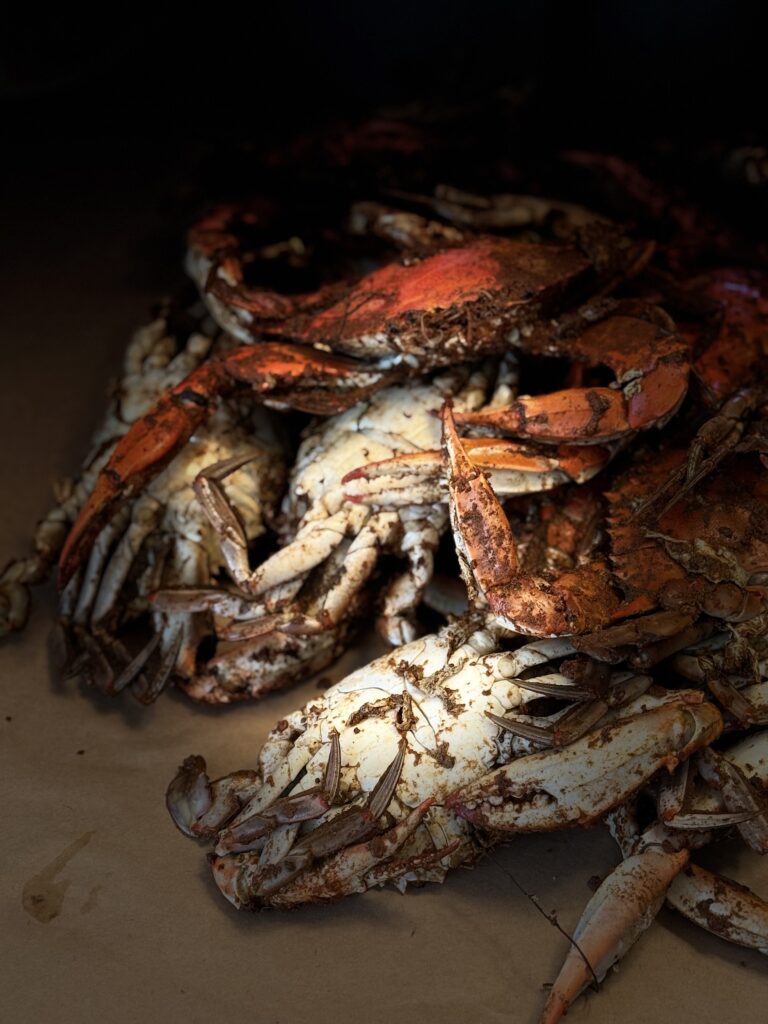
Maryland has three things no other state can offer: Maryland sweet corn, steamed crabs, and Old Bay.
Old Bay has been the unofficial seasoning of Maryland since 1939. I put that stuff on everything.
I really do. I’m a fifth generation Tidewater Maryland native on my mother’s side. I was born in a hospital on Swan Creek, a tributary of the upper Chesapeake Bay. The blood that runs through my veins is seasoned with Old Bay. I wasn’t too happy when McCormick bought the Old Bay brand in 1990, along with the recipe. I like the seasoning blend. I don’t like what McCormick has done to it; Old Bay branding and seasoning everywhere. Keychains. Socks. Hot sauce. Goldfish crackers. Ice cream. Seriously? Ice cream?
The best way to enjoy Old Bay is when it’s used to season a pile of steamed Chesapeake Bay blue crabs. A few decades back crabs were still affordable enough to be a way of life. In between impromptu crab dinners, family and friends gathered for a proper crab feast a couple of times each summer. A bushel of crabs, a couple of dozen ears of sweet corn, and a case of Natty Boh (National Bohemian beer…another Maryland staple), and you were set for the day. And well into the evening. As long as the crabs and beer lasted. The crabs almost always outlasted the Natty Boh.
In 1990 if you paid $40 for a bushel of crabs you paid too much. Nowadays that might get a dozen. Smalls. At today’s prices I can barely afford to buy a couple of dozen crabs once or twice each season. A dozen medium crabs are going for $60-$80 this summer, and a dozen jumbo crabs will set you back $100. When you can get them. Maryland’s crab population was decimated between the mid 1990s and into the early 2000s for a variety of reasons, mostly pollution and overharvesting. Which meant the price for what crabs you could get skyrocketed. The crab population has since largely recovered, but not the price.
Fortunately, I’ve discovered a way to stretch my enjoyment of crabs throughout the winter, without breaking the bank. Maryland crab soup. I cook it up in the summer and freeze it. Anytime I need a reminder of why I’m glad I haven’t moved to Florida — usually in the middle of a January snowstorm — a bowl of crab soup is all it takes.
The raw material for making crab soup is right there every time I bring home a couple of dozen crabs: the uneaten sweet corn I cook up to go along with the crabs, whatever crab meat didn’t get picked clean, the left over crabs that didn’t get touched, and even the shells themselves. I roast the shells, boil them down into a stock, and use that as the base for my soup. It adds a depth of flavor, and plenty of Old Bay, neither of which you’ll get from a carton of broth. McCormick’s exploitation of Old Bay hasn’t extended to broth. Yet.
When it comes to crabs, nothing goes to waste in my kitchen.
Except the dead man and the mustard.
* * *
My mother taught me and my siblings how to eat crabs when we were kids. She started by opening a crab in front of us and gave us the tour. I don’t remember much about being 10 yeas old, but I vividly remember my first crab.
The claw meat, she explained, was the appetizer: stringy and a little tough, but easy to get at and tasty enough to whet your appetite for the main event. The body was where the real treat lived, but it took patience and skill to get it out of the shell. Flip the crab onto its back, lift the little tab that looks like a rocket ship on its belly, and the top shell came right off.
Once the body was open, she pointed to the gray feathery stuff running along both sides — two rows of it, shaped like fingers. The dead man, she called it. Under no circumstances do you eat the dead man.
I was ten. I took this literally. The dead man would make you — a dead man. Or in my case, a dead ten-year-old.
What I learned later is that the dead man are simply the crab’s gills. They got the name of dead man, or dead man’s fingers, because they have the shape and color of a dead man’s fingers. You avoid them not because they’ll kill you but because they taste terrible and will ruin a mouthful of otherwise excellent crab. That said, being gills, they filter whatever passes through them — the Bay water along with all the toxins and heavy metals that are, sadly, a permanent feature of it. So, scraping out the gills and tossing them is the right call even if they won’t kill you straight away.
My mother watched me clean my first few crabs to make sure I got every bit of the dead man out. Then she chided me for the smallest morsel of meat I left behind in the shell. My small ten-year-old fingers were ideally suited for digging the crab meat out of the compartments it hides in. My patience was not.
She would pick up my discards, douse them in yellow goop from the middle of the crab, what she called the mustard, and finish them herself while I moved on to the next crab.
Now about that mustard…
My mother lied.
* * *
My mother told me the mustard was the crab’s fat and that it was good to eat. Before Old Bay came along, crab fat — the mustard — was used to season crab soup.
It is not the crab’s fat.
Anatomically speaking it is the crab’s hepatopancreas — a combined liver and pancreas that produces digestive enzymes and filters impurities from everything the crab consumes. Toxins. PCBs. Dioxins. Cadmium. Whatever doesn’t get absorbed by the gills and can’t be eliminated by the rest of the crab’s metabolism gets absorbed by the hepatopancreas. The FDA says it’s safe to eat in moderation. The New Jersey Department of Environmental Protection says don’t eat it at all. I’m with Jersey on this one. Even though they don’t know squat about steamed crabs the Maryland way, they’re smart enough to know not to eat the mustard.
The dead man, it turns out, was never the thing to worry about. The mustard is the true dead man of the crab. I grew up terrified of the wrong organ.
* * *
I don’t know if you’ve ever counted the number of crabs in a bushel, but there’s a lot. And for every crab feast I’ve ever attended, there were always uneaten crabs when the Natty Boh ran out. And sweet corn. Every self-respecting Maryland home cook has a way to deal with the leftovers from a crab feast. They make Maryland crab soup. And every Maryland family has a crab soup recipe they consider a family secret, handed down through the generations.
Except my family.
My mother may have grown up in Tidewater Maryland, but she cooked for my father, and he grew up in Appalachian Virginia. Where they don’t have crabs. Or Old Bay. My mother had great recipes for fried green tomatoes and ham hock and navy bean soup. She did not have one for crab soup. At least, not one that she shared with me.
So, when I decided to lay claim to my Tidewater Maryland culinary heritage by making my first pot of crab soup, I had to come up with a recipe of my own. I went down the internet rabbit hole in search of one and came out with a surprising discovery.
The secret in each family’s secret crab soup recipe is that they are all the same. There are no secrets in each family’s secret crab soup recipe.
The core ingredients are the same. Tomatoes. Sweet corn. Crab. That seasonal larder is not a coincidence; it represents things that Maryland is known for, because we have them in abundance. That larder is the recipe.
Oh sure, Marylanders add other things to their crab soup beyond those basic ingredients. Like green beans, cabbage or…lima beans (gag…not in MY crab soup). Each recipe claims those additions are what make it the best, giving that version of crab soup a flavor unlike any other. Different, yes. Better, no. As long as crab soup has a broth base with tomatoes, sweet corn, and plenty of lump crab meat, everything else is just…everything else.
The practice of making crab soup with whatever ingredients you have on hand has a history. Long before Leonard Calvert planted the family flag at St. Mary’s City, the Algonquin tribes that populated the Tidewater region made their own version of crab soup. The Algonquin dish was more stew than soup. And it didn’t have tomatoes…those were introduced later by Europeans. They did have crabs, in abundance. And clams. And oysters. The Algonquin name for the Chesapeake Bay translates into English as the “great shellfish bay” and they added their shellfish harvest into their crab stew, along with whatever root vegetables and cultivated crops they had on hand. Including their version of sweet corn.
Which brings me to the one thing I encountered that does make a difference in crab soup recipes: the seasoning.
And every Marylander knows that means Old Bay.
Or does it?
* * *
Just when McCormick was at the peak of their Old Bay marketing push, Mike Rowe of Dirty Jobs fame dropped a bombshell. Mike, a fellow native Marylander, informed an entire generation — my generation — that the crabs we grew up eating were not seasoned with Old Bay at all. They were seasoned with J.O. #2. You could hear heads exploding across the state. That was Maryland blasphemy.
So, what is this J.O. #2, and is there a J.O. #1? The J.O. Spice Company came to the Maryland seafood scene at the end of WWII, just a few years after Old Bay. It was formed by a Tangier Island resident who moved to the neighborhood surrounding Baltimore’s seafood markets. He brought with him an all-purpose seafood seasoning blend that he developed from family recipes handed down to him through the generations. He called it J.O. #1. Mystery solved. J.O. #2 came along later, a blend he came up with specifically for seasoning steamed crabs.
I like Mike Rowe and the working-class life he champions, and I had no reason to doubt him. Like me, he is a Maryland native. But as a culinary snob, I had to prove to myself that the crabs I love weren’t spiced with Old Bay. I ordered some J.O. #2 and ran my own head-to-head taste test.
What I learned from Mike Rowe’s show was that when it comes to seasoning steamed crabs, the secret is in the salt. Old Bay uses salt that is too finely processed to stick to crab shells as they are steamed. It does great in crab cakes and crab imperial. But when you season crabs with Old Bay and steam them, the Old Bay clumps up and falls off, leaving you with lightly seasoned crabs and heavily seasoned wastewater at the bottom of the steamer.
What makes J.O. #2 different, and better for steaming crabs, is the choice of salt. It was made to adhere to crab shells. To do that, J.O. #2 uses large and coarse rock salt flakes. The rest of the spices in the blend adhere to the salt, and the rock salt flakes stick to the crab shells throughout the steaming process.
When you pick a crab seasoned with J.O. #2, you can’t help but transfer the seasoning from the shell to your fingers, and from there to your mouth. Each bite delivers the perfect amount of J.O. #2 along with the crab meat.
Mike Rowe was right. My crabs — the crabs my mother taught me to pick — were not seasoned with Old Bay. They were seasoned with J.O. #2.
When I got the shipment of J.O. #2 I ordered for my taste test, it came with a paper insert that cautioned against using the seasoning for anything other than steamed crabs. The larger and coarse salt flakes would make anything else you used it in unpalatably salty. If you wanted something to season your seafood with, it said to use J.O. #1.
I ordered some J.O. #1 and ran another head-to-head taste test with Old Bay. This time the results were more subtle. More interesting.
McCormick’s Old Bay carried more paprika and cumin notes as well as celery, probably more chili as well. I found J.O. #1 to be a more complex seasoning blend, with a better balance of soft notes. Once I got past the red and black pepper, the chili, mustard, cumin and celery seed — all of which hit you me front — I started to get more nuanced flavors like cinnamon, clove, nutmeg and crushed bay leaf. It’s probably no coincidence that those are the seasonings Marylanders used in their crab soup before Old Bay came along.
So…when a Maryland crab soup recipe says add copious amounts of Old Bay, what it really means is to add copious amounts of whichever Chesapeake seafood seasoning blend your family swears by. That’s a controversy that’s been dividing Marylanders for 80 years, and one that won’t be resolved in my lifetime.
For me, after my taste tests, it’s J.O. #2 for my steamed crabs, and J.O. #1 for my crab soup. As for the rest of my dishes, it’s Old Bay all the way. I put that stuff on everything. Just not in my crab soup. And not on my ice cream. I draw the line at ice cream.
Get the recipe here: https://welltraveledwellfed.substack.com/p/maryland-crab-soup