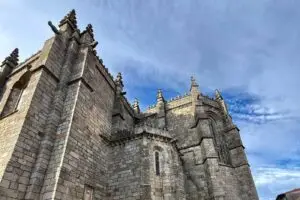
High on the roof of the cathedral in Guarda, Portugal’s highest city, sits a gargoyle with a very blunt opinion about Spain. Getting the joke takes a little history. Nine centuries of it, starting with a mother, a son, and a county neither one would give up.
Here’s the whole story, followed by the route we traveled from Porto to Lisbon, city by city.
In the early twelfth century, the Iberian Peninsula was a shifting patchwork of Christian kingdoms in the north and Muslim realms in the south, held together more by marriage and the sword than by borders. The largest Christian kingdom, León-Castile, belonged to Alfonso VI. It included the County of Portugal, which Alfonso ultimately gave to his illegitimate daughter, Teresa of León, and her husband Henry, a Burgundian nobleman. The county took its name from Portus Cale, the old Roman port at the mouth of the Douro we now call Porto, and it sat on the frontier between Galicia and the Muslim lands. Alfonso VI died in 1109, and León-Castile promptly fell into civil war among his heirs, with Teresa and Henry fiercely protecting their legitimate claim to Portugal.
When Henry died in 1112, Teresa took sole charge of the county, and with León-Castile still at war with itself, she began styling herself queen. Few objected to the title. They were too busy fighting for control of León-Castile. Her choice of companion was another matter. The Galician count Fernão Peres de Trava became the power behind her court, and Portuguese lands and castles began flowing to him and his Galician relatives. The Portuguese nobility, and the powerful Archbishop of Braga, were not amused. They found their rallying point in Teresa’s son, Afonso Henriques. Maybe they should have called him Afonso Noel? Give it a minute. It’ll come to you.
Born around the time of Alfonso VI’s death, in the town of Guimarães (near Braga), Afonso Henriques knighted himself at the age of 14 and set out to take the county from his mother and send the Galicians packing. When I think about 14-year-olds of today, I can only imagine the drama. It didn’t end well for momma.
Our guide’s version had Teresa’s army besieging Guimarães in 1127, trying to tunnel under the walls and hitting solid granite wherever it dug. After numerous tries, and failures, Teresa’s army folded its tents and went home, leaving Afonso to rule Portugal as king.
Great story. The history books tell it differently. The siege was real, but it was led by Teresa’s nephew, the new King of León, and it ended when Afonso’s tutor, Egas Moniz, pledged the young prince’s loyalty to the king. Afonso didn’t keep the pledge. Rather cheeky of him, though to be fair, he wasn’t the one who made it, and he was an adult by the time he reneged on it. The real showdown came the next summer at the Battle of São Mamede, just outside Guimarães, where Afonso’s army beat his mother’s in the open field. By 1139 he was calling himself King Afonso I of Portugal, and by 1143 even León and Castile had to accept it.
I would not want to have been at that family’s Christmas dinner. A thoroughly steamed Teresa was banished to Galicia, where she died two years later, probably swearing at that ungrateful son of hers every day of her exile. In a final irony, she was buried beside her husband Henry in Braga’s cathedral, a short ride from the battlefield where her son defeated her.
With his mother out of the way, Afonso turned south. He moved his capital to Coimbra, where he’s buried today, and went after the Moors occupying the south. Porto handed him his biggest prize. In 1147 a fleet of English, Flemish, and German crusaders bound for the Holy Land put in at Porto, and the city’s bishop talked them into a detour. His pitch included the promise of plunder. It worked. Alongside Afonso’s army, the crusaders besieged Lisbon for four months and took it. Our tour ran the same direction, Porto to Lisbon. It just took us less time. And there was no plunder for us.
Back to the Sé da Guarda. Afonso’s son, Sancho I, founded Guarda in 1199 on high ground facing the Spanish frontier. Guarda means guard. The name says it all. Two centuries later, with Portugal still fighting off Castile, the city began building its third cathedral, the one with the gargoyle tribute.
To get to today’s Portugal you have to fast-forward through four royal houses (one of them Spanish, though the Portuguese would rather you forget), the Age of Discovery, a 1910 revolution, and nearly half a century of dictatorship, most of it under António de Oliveira Salazar. Our guide simply called it “the Dictatorship.” I could almost see her wanting to spit every time she said it. I think she may have, a time or two. The dictatorship ended on April 25, 1974, when young army officers toppled the regime in the nearly bloodless Carnation Revolution, named for the carnations crowds stuffed into the barrels of the soldiers’ rifles. Just about every city and town in Portugal now has a street, square, or bridge named for the 25th of April.
Our Route
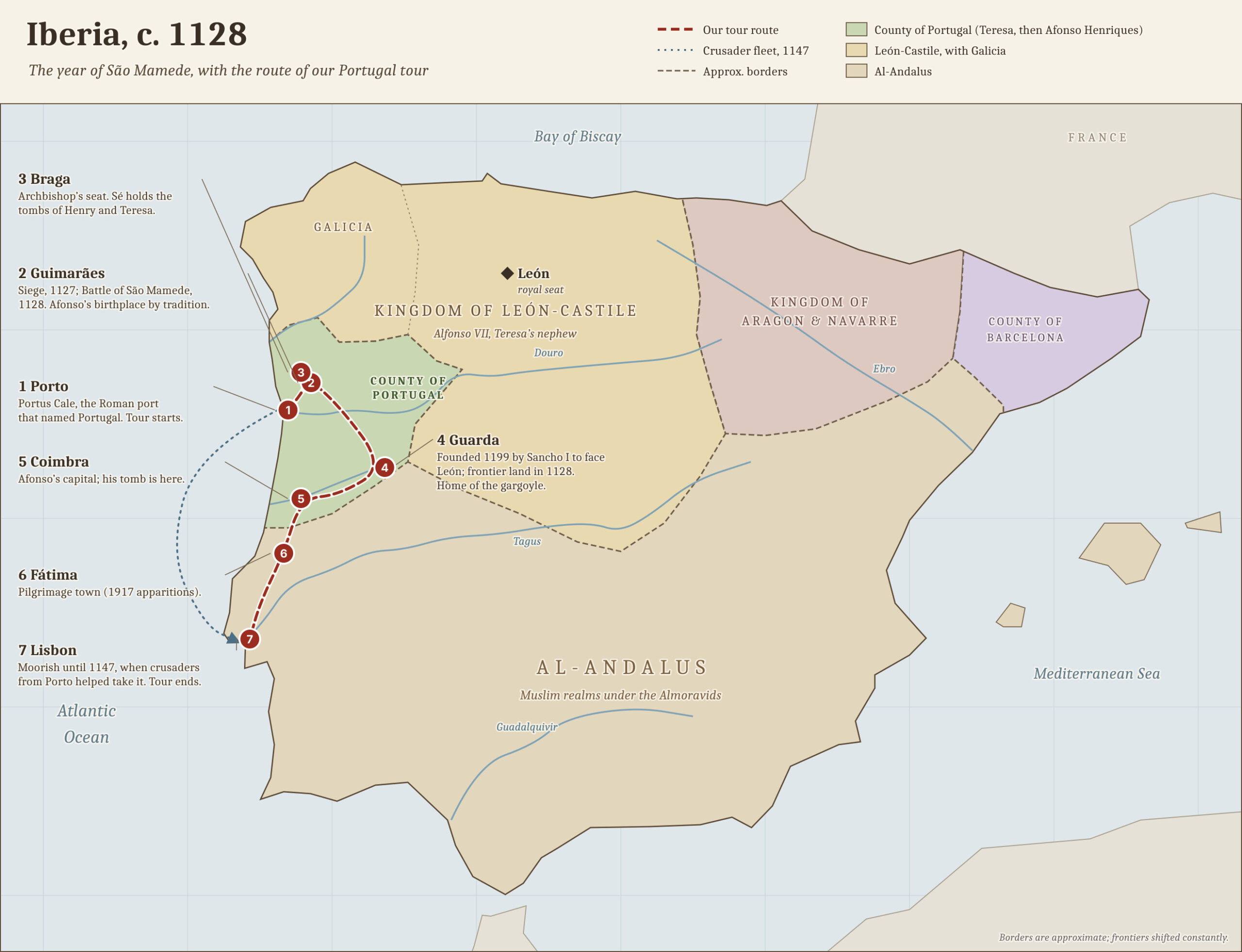
Our tour traced Portugal’s reality TV history across the country. We started in Porto, the city that gave Portugal its name, then headed to Braga, the country’s religious heart, with a stop in Afonso’s stomping grounds of Guimarães on the way. From there we climbed, by motor coach thankfully, into the granite highlands along the Spanish border to Guarda. Heading back toward the coast we stopped in the college town of Coimbra on the way to the Catholic pilgrimage town of Fátima before finishing in Lisbon.
| Leg | Approx. distance | Approx. time | Best way |
|---|---|---|---|
| Porto → Guimarães → Braga | 80 km / 50 mi | 1 hr plus stop | Train (frequent) or car |
| Braga → Guarda | 250 km / 155 mi | 2.5–3 hrs | Car; transit is slow |
| Guarda → Coimbra → Fátima | 250 km / 155 mi | 3 hrs plus stops | Car |
| Fátima → Lisbon | 130 km / 80 mi | 1.5 hrs | Car or bus |
Planning note: You can book this as an escorted tour or plan a self-guided trip. Guarda is well off the Porto–Lisbon corridor near the Spanish border, but either way it’s worth including. Trains won’t help much, so you’ll want to book a tour, a private driver, or a rental car with a Via Verde transponder for the electronic tolls. Skip the car in Porto and Lisbon, where steep, narrow streets and scarce parking take the fun out of driving. Take an Uber or use the streetcars, though our guide insisted the only people who ride the streetcars are tourists — because locals won’t pay the fare when Uber is cheaper. I don’t know about the locals bit, but when we toured Lisbon apart from our group, Uber was indeed cheaper and faster than the alternatives.
Porto
- Region
- Norte; on the north bank of the Douro River near the Atlantic
- Population
- ~230,000 city; ~1.7 million metro
- UNESCO
- Historic Centre (Ribeira) inscribed 1996
- Known for
- Port wine, azulejo tiles, bridges, the Ribeira waterfront
- Time needed
- 2–3 days
Background
Porto is Portugal’s second city and, in a real sense, its first. It’s a working, granite-gray, hill-stacked city with a reputation for being prouder and more independent than Lisbon. We spent a few days there before our tour began and found it delightful.
Residents are nicknamed tripeiros, tripe-eaters, from a tradition that in 1415 the city gave all its meat to Prince Henry the Navigator’s fleet, keeping only the offal. Tripe and white-bean stew is still the city’s signature dish. And by the way, Prince Henry never went exploring. Apart from a few military campaigns in North Africa, he stayed home. He got the nickname “The Navigator” because he paid the bills for those who did. Our guide also told us, repeatedly, that the Portuguese have 365 ways to make salt cod, one for every night of the year. Most of that cod isn’t Portuguese; more than half of it comes from Norway. You know that when I travel, I love to eat like a local. But I could not get myself to try anything with tripe in the name. I’ve had it. I don’t like it. I also passed on the cod. I get plenty of that at home, and it isn’t Norwegian. It’s Alaskan.
Porto is most famous for port wine, Janet’s favorite after-dinner treat. The grapes grow upriver in the Douro Valley, but the wine was aged and shipped from the lodges of Gaia, across the river. The port trade boomed in the late 1600s when England, at war with France, needed a new source for its wine. To keep it from spoiling on the voyage, the port houses fortified it with brandy. It quickly became the Brits’ preferred beverage, probably because of the brandy. I’m not judging. That British trade is why so many port houses carry English and Scottish names: Taylor’s, Graham’s, Sandeman, Cockburn’s.
Key sights
- Ribeira – The riverfront quarter of colorful stacked houses; the postcard view. We enjoyed a short river cruise under the six bridges connecting Porto to Gaia.
- Dom Luís I Bridge (1886) – Two-level iron bridge designed by a former partner of Gustave Eiffel. The connection to Eiffel shows. Walk the upper deck for the best views of the city.
- Douro Valley – A must-do day trip into the terraced port vineyards. Or book a weeklong Douro River cruise, which we have planned for 2027.
- Majestic Café – Belle Époque café on Rua de Santa Catarina, said to be where J.K. Rowling wrote while teaching in Porto. A better Harry Potter stop than the much-hyped Livraria Lello bookstore, rumored to have been the inspiration for Hogwarts. The line for timed tickets snaked well into the plaza, even though Rowling debunked the Harry Potter connection directly.
Food and drink
- Francesinha – A heroic sandwich of steak, sausage, and ham under melted cheese and a beer-tomato sauce, usually served with fries. It sounded heavy, so we passed.
- Bacalhau in many forms, caldo verde (kale and potato soup), and grilled sardines in summer.
- Port – Ruby, tawny, white (try a port tónico), and vintage. And vinho verde from the Minho to the north; the verde in this case means young, not green. Janet enjoyed the vinho verde as well as the port.
Braga
- Region
- Minho, Norte; about 55 km northeast of Porto
- Population
- ~195,000 (municipality)
- UNESCO
- Sanctuary of Bom Jesus do Monte, inscribed 2019
- Known for
- Churches, Baroque, Holy Week, the oldest cathedral in Portugal
- Time needed
- 1 full day (more with Guimarães)
Background
The Romans founded Braga around 16 BC as Bracara Augusta, in honor of Caesar Augustus. For centuries after, the Church effectively ran the city. Hence the saying: Lisbon plays, Porto works, Coimbra studies, and Braga prays. Today that piety shares the streets with a young university crowd. The University of Minho is here, and its students still wear the black capes that look like something straight out of Hogwarts. Rowling may have debunked the Lello story, but she did teach English in Porto in the early 1990s while working on the first Harry Potter book, and those student capes are widely credited as the inspiration for the Hogwarts robes. Holy Week in Braga is the most elaborate in Portugal. On the drive up we stopped in Guimarães, Afonso’s birthplace, whose medieval center is also a UNESCO site.
Key sights
- Bom Jesus do Monte – A hilltop sanctuary reached by a zigzag Baroque stairway of nearly 600 steps, lined with chapels and fountains. Pilgrims traditionally climb on their knees. We took our motor coach, and with my 65-year-old knees, I’m not even feeling guilty about that. The grounds and church are free.
- Bom Jesus Funicular (1882) – The oldest water-powered funicular still running in the world. Water fills a tank in the upper car, and its weight pulls the lower car up in about three minutes. Ride up, walk down.
- Sé de Braga – Portugal’s oldest cathedral (consecrated 1089). Look for the tombs of Count Henry and Dona Teresa, parents of Afonso Henriques. Yes, that Teresa.
Food and drink
- Bacalhau à Braga – Fried salt cod with onions and fried potatoes.
- Frigideiras do Cantinho – Savory puff-pastry meat pies sold since 1796. Delicious.
- Vinho verde – The Minho is its home region. Janet preferred the Alvarinho.
Guarda
- Region
- Beira Alta, Centro; about 40 km from the Spanish border
- Elevation
- 1,056 m (3,465 ft), the highest city in Portugal
- Known for
- Granite Gothic cathedral, Jewish quarter, Serra da Estrela, cold
- Nickname
- “City of the Five F’s”
- Time needed
- Half to full day; base for the Historic Villages
Background
Salazar’s dictatorial regime claimed to keep the people content with three F’s: Fado, Fátima, and Futebol. Music, faith, and soccer. Guarda goes him two better, describing itself with five: Farta, Forte, Fria, Fiel e Formosa. Abundant, strong, cold, loyal, and beautiful. The cold is no joke. Guarda gets more snow than any other Portuguese district capital. Pack layers. We did, and we were glad of them on the one brisk October morning we spent there.
This is the least-touristed stop on the route, but it’s worth the detour. It’s a dark-granite mountain town with a medieval core and the gateway to the Serra da Estrela mountains, mainland Portugal’s highest range, and to a string of fortified border villages most visitors never see.
Key sights
- Sé da Guarda – Built 1390–1540 in local granite. From outside it looks more fortress than church; inside are soaring naves, twisted columns, and a huge carved-stone altarpiece. Small entry fee, with a slight extra charge to walk the roof terraces. Worth it, and that’s where you’ll find the gargoyle.
- Praça Velha – The arcaded square in front of the cathedral, with café terraces under the arches.
- Jewish Quarter (Judiaria) – Narrow streets with doorways still bearing marks carved by the Jewish community before the expulsions and forced conversions of 1496–97.
Food and drink
- Queijo Serra da Estrela – Portugal’s most celebrated cheese, from raw sheep’s milk curdled with thistle; ripe wheels are soft enough to spoon.
- Roast kid (cabrito), cured mountain sausages, and Dão wines from the region next door.
Fátima
- Region
- Centro; about 130 km north of Lisbon
- Known for
- Sanctuary of Our Lady of Fátima, one of the world’s major Marian shrines
- Big dates
- The 12th–13th of each month, May–October; especially May 13 and October 13
- Time needed
- Half day; stay overnight to see the candlelight procession
Background
Of all the stops on our tour, this was the one I could have skipped. In 1917, three shepherd children, Lúcia dos Santos (10) and her cousins Francisco (8) and Jacinta Marto (7), reported six apparitions of the Virgin Mary between May and October, most of them on the 13th of the month. The last, on October 13, drew a crowd estimated in the tens of thousands, many of whom reported the “Miracle of the Sun.” Pope John Paul II later credited Our Lady of Fátima with saving him from a 1981 assassination attempt, and one of the bullets is set in the crown of her statue.
Francisco and Jacinta died in the 1918–20 flu pandemic and were canonized in 2017. Lúcia became a Carmelite nun, lived to 97, and popes came to see her, yet she still isn’t a saint. What more does it take? Paperwork, it turns out. The process doesn’t start until after you die, and Lúcia died in 2005. She was declared Venerable in 2023; one confirmed miracle gets her beatified, a second makes her a saint. How did I not know that? I’m Lutheran (Catholic Lite). We believe in saints, just not in canonizing them or praying to them.
Whatever your beliefs, Fátima is worth seeing for the scale of devotion, and after seeing it, I’m glad I didn’t skip it. Millions of pilgrims arrive each year, some walking for days, and the town is largely hotels, restaurants, and religious-goods shops serving the sanctuary. Dress modestly and keep your voice down. It’s an active place of worship.
Key sights
- Chapel of the Apparitions (Capelinha) – Built on the spot of the apparitions, with near-continuous services.
- Basilica of Our Lady of the Rosary – The neoclassical basilica with the tall tower; tombs of all three seers.
- The esplanade – Larger than St. Peter’s Square. Note the smooth path where pilgrims advance on their knees. We noted it, standing.
- Candlelight procession – Follows the 9:30 pm rosary at the Capelinha. Since February 2025 it runs every night of the year, weather permitting. This is the moment to be there. We were there. Sound asleep in our hotel room after a long day of touring.
Lisbon
- Region
- Capital; on the north bank of the Tagus estuary
- Population
- ~550,000 city; ~2.9 million metro
- UNESCO
- Jerónimos Monastery and Belém Tower (1983)
- Known for
- Hills, trams, tiles, fado, the Discoveries, pastéis de nata
- Time needed
- 3–4 days
Background
In the 1500s Lisbon was one of the richest cities on earth, with spices, gold, and goods from Asia, Africa, and Brazil passing through its port. On the morning of November 1, 1755, All Saints’ Day, with churches full and candles lit, a massive earthquake struck. A tsunami and days of fire followed. Tens of thousands died. The Marquis of Pombal rebuilt the lower town on an orderly grid with some of the earliest earthquake-resistant construction in the world.
The older neighborhoods that survived, like Alfama, still have their tangled medieval streets. We took an Uber to the lower part of Alfama and walked the rest. Uphill. After circling the neighborhood, we rewarded ourselves with a traditional Portuguese dinner on one of its narrow streets. Alfama is the place to hear fado, Lisbon’s song of longing. When the singing starts, the talking stops. Conversation during a fado is considered rude.
Key sights
- Jerónimos Monastery (Belém) – Built with spice profits; Vasco da Gama is entombed in the church (free). The cloister costs €18. Book a timed ticket online, or plan on a long line.
- Belém Tower – Early-1500s fortress in the river. It reopened in May 2026 after a year of restoration, with timed half-hour entry slots, so book it separately. We skipped the tour but got a good look from outside. To me, it looks like a giant meerschaum pipe.
- Pastéis de Belém – Custard tarts since 1837, from the Jerónimos monks’ recipe. You’ll find pastéis de nata all over Portugal, but the Belém recipe is a closely kept secret sold only here, so it’s worth a taste if the line is short. Our guide stood in line for us while we toured. Tasty, but honestly? They can’t hold a candle to the bichon au citron I had in Lyon.
- Castelo de São Jorge and the Alfama viewpoints – The climb isn’t easy, but the view is worth the effort.
- Tram 28 – The classic yellow tram that rattles through Lisbon’s old neighborhoods, and the one you see on every postcard. It’s also crowded and a pickpocket favorite, so ride early in the morning and guard your wallets and purses. Or do what we did. We took an Uber halfway up and walked the rest of the way, using the tram tracks as our guide and taking our own postcard pictures of the tram. With all the stops the tram makes, we made better progress on foot.
Food and drink
- Bacalhau à Brás – Shredded salt cod with egg and matchstick potatoes.
- Grilled fish – Sardines are the classic, especially in June. Janet skipped the sardines but enjoyed a delectable bream dish.
- Ginjinha – Sour-cherry liqueur sold by the shot at tiny bars near Rossio.
Lisboa Card (2026): €31 for 24 hours, €51 for 48, €62 for 72. Covers public transit and entry or discounts at many sights, including Jerónimos.
One last tip: Restaurants bring bread, olives, or cheese to the table unasked, and you’re charged if you eat any of it. Even a single olive. It’s fine to send them back, and you won’t be charged. But do it when they arrive, not after they’ve sat on the table the entire meal.
About That Gargoyle
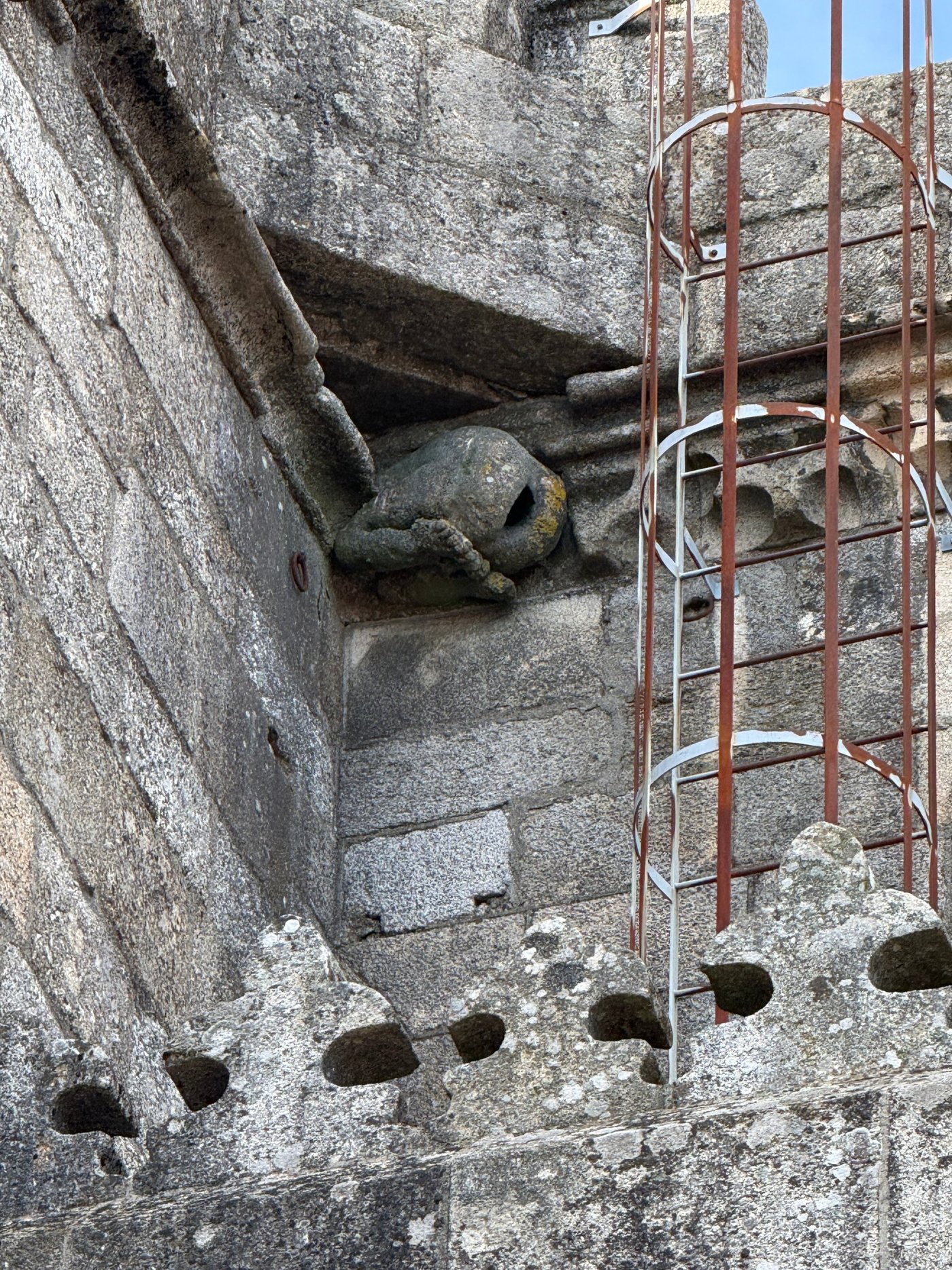
Most gargoyles show off their faces, usually a snarling open-mouthed grimace. The mouth is open for a reason: it’s the spout that drains rainwater off the roof. The figure carved into the eaves of Guarda’s cathedral as a tribute to Castile (modern-day Spain) doesn’t show its face. It can’t — it’s bent over on its knees, facing inward, and what faces Spain is the other end. The stonemasons drilled the drain hole there instead, so the tribute is, quite literally, a gargoyle’s butt pointed at Spain. When it rains, our guide told us, the gargoyle appears to be relieving itself in Spain’s direction. That’s what Portugal has thought of its neighbor for hundreds of years, memorialized in stone. Considering how many times Spain tried to take Portugal, and the 60 years it succeeded, I’d call that a fitting tribute.
Thinking about Portugal?
Escorted tour or self-guided, with or without the detour to Guarda, we can help you plan the route, the hotels, and the time you need in each city.
Talk to Jeff