Why the Bird Tastes Like Nothing
How Big Ag bred the flavor out of the Thanksgiving turkey, and what the labels on the package really mean.
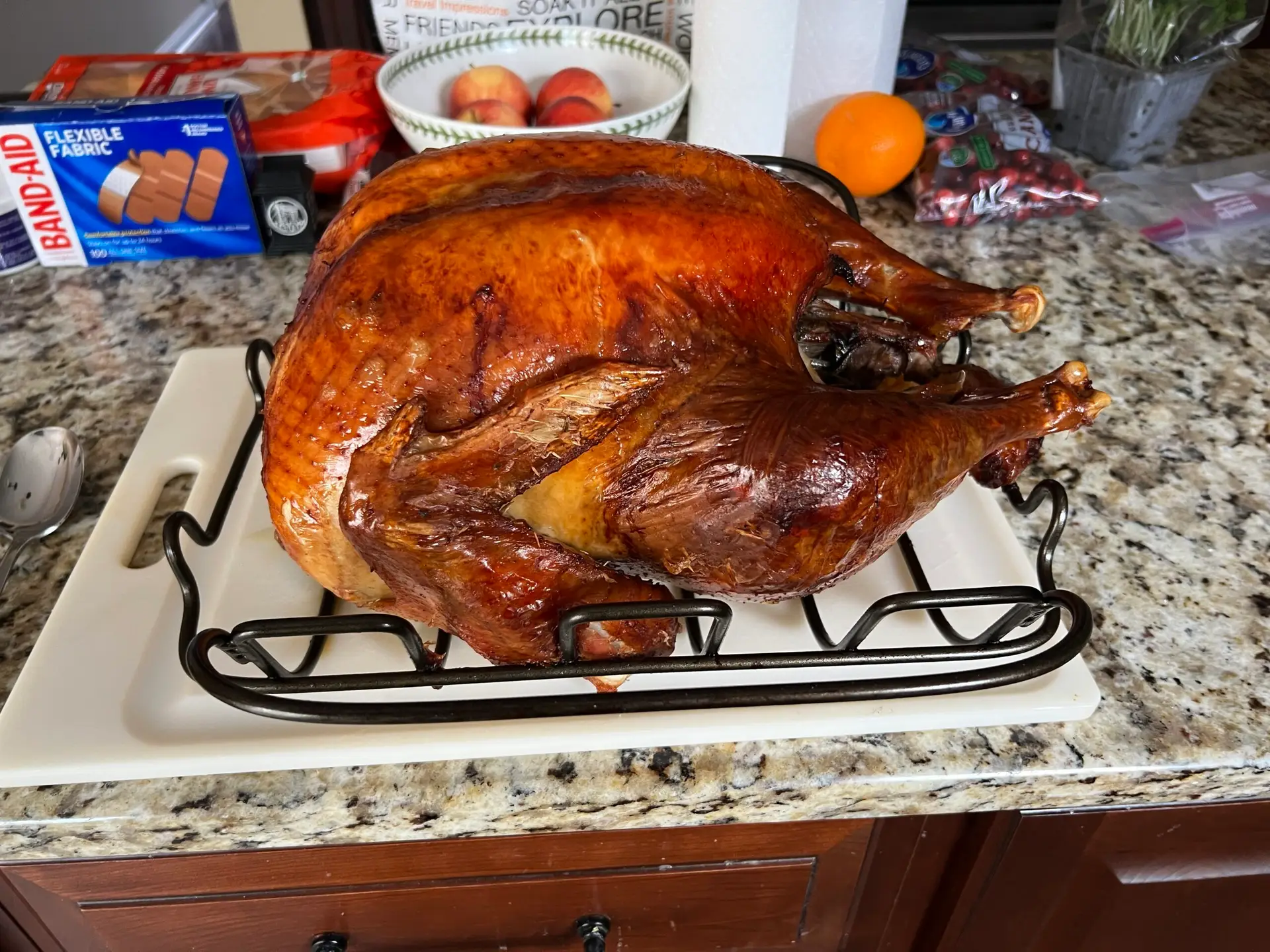
Tradition! If you read that with the rich baritone of Chaim Topol (aka Tevye) resonating in your head, you understand where I’m coming from with this article. I believe in tradition, especially when it comes to the holidays. It gives us an anchor in an otherwise turbulent world. Tradition reassures us that no matter how much change surrounds us, some things stay the same, and I take comfort in that.
One of my favorite traditions is Thanksgiving, and one of my favorite Thanksgiving traditions is the turkey dinner. Back in 2022 I wrote a three-part series about turkey, built around taste tests I ran in 2021 and 2022. The bird hasn’t changed, but I’ve updated the articles to reflect how turkey is treated today, five years later. This first part covers the basics: why the modern turkey has such little flavor. That hasn’t changed and it won’t change. As long as the American palate demands an unnatural balance of white to dark meat, our turkey dinner will remain more or less tasteless. What has changed is what the labels on the packaging really mean. Part 2 is the taste test. Part 3 is what you can do about it.
There is a Hallmark movie called “Holiday Hotline” (aka “Let’s Talk Turkey”) that I absolutely love. The Hallmark Channel was the one item Janet insisted we preserve when we ditched our cable subscription in favor of streaming services. The story line follows a British chef who takes a break from the rigors of commercial cooking to spend a month in America, miraculously losing her British accent along the way. She takes a job as an operator at a turkey help-line, helping people (like me) navigate the many potential disasters we face when preparing Thanksgiving dinner. Blah Blah Blah in the end the girl gets the guy, and their Thanksgiving turkey dinner turns out perfectly. Of course.
Like many American families, as far back as I can remember my Thanksgiving tradition was an oven-roasted turkey with all the usual side dishes, right down to the barely edible green bean casserole. Even when I was in the Army and spent two Thanksgivings in Turkey (the country), I had turkey (the bird) for my Thanksgiving dinners. They were shipped in through the military commissary system, which means they spent at least the prior year, possibly more, in the bottom of a freezer somewhere. It didn’t matter. It brought an American Thanksgiving to this American serving his country in a foreign land. I had to give up a lot living in Turkey, but a dry and tasteless turkey wasn’t one of those things. The local Turkish cooks that prepared our food somehow made turkey taste really good. Probably it was just the nostalgia, combined with the thick steaks and huge (and I mean HUGE) lobster tails they cooked up to go along with the turkey. Not my parents’ Thanksgiving dinner I can tell you that.
I’ve made the point in prior posts that when I was a kid, my family was poor. My father worked hard to provide for his family of seven kids, first in the Army and then, after retiring, as a security guard. And my mother worked even harder to keep our bellies full on a meager food budget. To their credit, I didn’t realize we were poor until I became an adult. My parents made sure my siblings and I never lacked for the basics, even if it meant eating Campbell’s Pork and Beans (gag) and wearing thrift shop and hand-me-down clothes.
When it came to Thanksgiving, my parents didn’t have the luxury of choice. During my father’s service in the Army, our turkey came from the commissary. It was affordable, mostly because it had been sitting in the bottom of a freezer for a year or two. Not the best source for a tasty turkey, but it made that turkey in Turkey a throwback to my youth. After my dad retired and took the security guard job, our holiday turkeys came off the back of a truck. Not the “I know a guy” kind of truck (which, by the way, I have no problem with), but the company kind. Every holiday season his employer, the Bata Shoe Company of Belcamp, Maryland, had a truck full of frozen turkeys delivered to the plant. And they didn’t skimp. They were Butterballs. Each employee got one turkey to take home as their annual holiday “bonus.” As the security guard on duty, my dad got to dole out the turkeys, which meant he saved the biggest bird for us. My dad would have preferred a cash bonus, I’m sure, but I was happy with the turkey. Tradition!
My mother was constrained in her kitchen by a hopelessly tight food budget. I am not. Through the years I’ve tried almost everything in a Bubba Gump–esque pursuit of turkey perfection: fresh turkeys, kosher turkeys, wet-brined turkeys, dry-brined turkeys, unbrined turkeys, free-range turkeys, name-brand turkeys, store-brand turkeys, generic turkeys, hormone- and antibiotic-free turkeys. You name it, I’ve tried it. I’ve paid as little as $13.50 for a 20-pound marked-down store-brand bird, $120 for a free-range turkey from a local farm that was slaughtered the day before I picked it up, and an eye-watering $275 for a heritage breed turkey from a specialty poultry house. Spoiler alert: the $13.50 turkey was the best of the lot. But you’ll have to read Part 2 to find out why.
The only turkey that tasted noticeably different from the generic birds my father brought home from the bottom of the commissary freezer or the back of that truck was the heritage breed. A few years ago, I bought a Bourbon Red, a name that refers to the color of its plumage and its origins in Bourbon County, Kentucky, not because of the taste. As a former bourbon lover, you can imagine my disappointment. It was pricey, but it had flavor. Trouble is, after spending a ton of money on it, I discovered I didn’t particularly care for the heritage flavor. Maybe if it had even a hint of bourbon as the name implies it would have been more to my taste.
Why do we celebrate such an important holiday with a centerpiece as bland as turkey anyway? We have our choice of entrées nowadays, so why not lasagna for Thanksgiving? I like lasagna. Or manicotti. Janet makes a really good manicotti, with shells stuffed so full of ricotta they explode. I get why turkey was the main course at the first Thanksgiving. Work with what you’ve got and all that. And wild turkey surely had plenty of gamey flavor in the 1600s. But not the commercial turkeys we’re stuck with now. Tradition!
The reason it’s nearly impossible for a home cook to coax much flavor out of a turkey is that it has none to give. You can thank Big Ag for that, the agricultural industry that produces most of the food we eat. By the 1960s, not long after I was born, the poultry industry set out to breed a turkey that was inexpensive to raise, because that’s what Big Ag wanted, and carried more breast meat on its bones, because that’s what consumers wanted. Flavor was not on the list of required attributes. Through selective breeding (aka genetic manipulation the “natural” way) Big Ag built a bird that delivered the white meat consumers wanted, and one that grew fast enough to save producers money. Cost-effective with maximum return on investment. Words Big Ag lives by. Words that result in turkey with no turkey flavor.
The result was a marvel of agricultural genetic engineering: the broad breasted white turkey. This is a breed that goes from egg to market weight in four or five short months. In that time, it packs on a ridiculous amount of muscle, mostly in the breast. Hence the name. In the process of building a bird with an accelerated growth rate and massive breasts, Big Ag bred out the taste. Broad breasted white turkeys have no taste. They just don’t. None.
Nearly every turkey sold in nearly every grocery store today is a broad breasted white, and every one of them comes from an artificially inseminated egg. Why artificially inseminated? Because the breeding of the ’60s produced a bird with such massive breasts, it is physically incapable of mating. They live short lives and they don’t get to have sex. Not even once. Their legs can barely carry those breasts as it is, and even if they could manage the acrobatics, they still couldn’t do the deed. Their breasts get in the way.
Those huge breasts are also the reason broad breasted whites cook up so dry. By the time the deepest part of the breast reaches the USDA’s safe temperature of 165°F, the rest of the bird is overcooked. Whatever flavor your turkey might have had gets cooked out before it makes it to the table. That’s the price of killing off the salmonella turkeys are infested with. They live packed by the thousands in houses sized for a few hundred, where they spend their short, sexless lives standing in their own salmonella-filled droppings. Thanksgiving lasagna is sounding better and better, isn’t it?
Now a few words about labels. Most of what you read on a turkey’s packaging is marketing. The more stuff on the label, the higher the price per pound. Sadly, none of it translates into a moister, more flavorful turkey. Here is the most common labeling that jacks up the price without doing a thing for the flavor:
- Free Range or Free Roaming
- This does not mean your Thanksgiving turkey lived its best life (short and sexless though it was) roaming a farm’s idyllic hills, foraging for bugs, worms, and seeds. The only thing the USDA requires for this label to be applied is that the birds have access to an open door in the growing house, giving them access to the outside. Nobody makes them use it, and most never do. Why would they? Their scrawny legs barely function. The only thing outside does for them is to take them away from their steady supply of food and water. And by staying indoors, they get to keep their legs intact. Well, most of them do. Some still break a leg just standing at the feeding trough. Freaks.
- Cage Free
- Meaningless for turkeys raised for meat. They aren’t kept in cages to begin with. Overpacked poultry houses yes. Cages, no. A cage might be an improvement.
- No Growth-Promoting Antibiotics
- Technically true, but meaningless. Federal rules have barred using antibiotics to promote growth since 2017. That doesn’t mean the bird never had antibiotics. It may still have gotten them to treat or prevent disease. Just not to make it grow.
- Antibiotic Free or No Antibiotic Residues
- Neither is a claim the USDA approves, yet you’ll still see them. Every turkey sold has to be clear of antibiotic residues by law, because producers must stop any antibiotic treatment long enough before slaughter for the drugs to leave the bird’s system. The labels that do mean something are “Raised Without Antibiotics” and “No Antibiotics Ever,” which the producer has to back up with documentation that the birds never received any. If that matters to you, those are the words to look for. Just don’t expect the bird to taste any different. It won’t.
- All Natural
- Another label that sounds like more than it is. The USDA’s definition of “natural” is simply no artificial ingredients or added color, and minimal processing. That describes just about every whole turkey on the shelf, whether it says so on the label or not. There is nothing natural about a broad breasted white turkey. They are all freaks of genetic cross-breeding.
- Raised Without Hormones
- Yet another meaningless label. Federal law prohibits hormones in all poultry, which is why any turkey making this claim also has to carry the line “Federal regulations prohibit the use of hormones.” At best the label is redundant. At worst it’s misleading, especially if the bird costs more than one without it. Let me make it simple: whether the label says so or not, NO TURKEY SOLD IN THE US IS RAISED WITH HORMONES.
- Premium
- There is no USDA standard or definition for this term, which makes it meaningless on a turkey label. The only thing premium about a premium turkey is the price.
- Farm Names
- Just because the label names a farm doesn’t mean your turkey came from that farm. Case in point: Shady Brook Farms. Not a farm. It’s a brand owned by Cargill, one of the biggest names in Big Ag, which sources its turkeys from hundreds of independent farms. You’ll find Shady Brook Farms turkeys at grocery chains across the country, generally for more than a store-brand bird, even though the store-brand bird may have come from the same farms.
- Fresh, Never Frozen
- I’ll dig into this one in Part 2. For now, here’s what the label means: the USDA lets a turkey be sold as fresh never frozen as long as the core temp has never dropped below 26°F. Turkey meat freezes at 28°F, so a “fresh” bird is frozen in every sense except the formal USDA definition. At least until the grocery store thaws it for your convenience.
In all my years of buying turkeys, I’ve found only one exception to my rule that broad breasted whites have no flavor. There are probably others, small producers and hobby farms, but this one is special: Jaindl Farms. For about 50 years, Jaindl has supplied the turkey for the White House Thanksgiving dinner. Not the birds that get pardoned for the TV cameras. These turkeys get cooked and eaten.
Jaindl Farms is a family-owned and operated farm in Pennsylvania’s Lehigh Valley. It’s a legit local operation, but it isn’t small. They raise about 750,000 turkeys a year, though that pales next to giants like Butterball, Jennie-O, and Cargill, which each turn out tens of millions.
What makes Jaindl turkeys so good is that the family controls every step: they grow their own feed, breed and hatch their own birds, raise them, and process them. They treat their turkeys like a small hobby farm would, even at their size, and it shows in the flavor. You won’t find them everywhere. Wegmans sells them under its own label as Wegmans Premium Holiday Grand Champion, and Whole Foods and Stew Leonard’s carry them too. At Wegmans, check the metal clip on the bag: if it reads “P-460,” you have an authentic Jaindl turkey.
If you have a Wegmans or Whole Foods nearby, a Jaindl turkey is the best value for your turkey dollar. It’s my go-to bird. If not, don’t stress. Pick up the least expensive generic or store-brand bird you can find, because they all taste the same: bland. And don’t pay extra for a fresh turkey unless it’s worth the price difference for you to skip the four- or five-day thaw in your fridge. Modern packaging and freezing make a frozen turkey every bit as good as a fresh one, and as I noted, fresh means frozen but thawed for your convenience.
No matter what bird you buy or where you buy it, about the only good thing I can say about turkey is that the carcass and leftover meat make great soup. And it gives the stuffing something to sit next to. The bird may be the centerpiece of the Thanksgiving table, but on my table the stuffing is the star. Because unlike the turkey, it has flavor. I like turkey, I do. Especially for Thanksgiving. Not because it tastes good. It has no taste. I like it because…Tradition!