Jeff’s Test Kitchen
A $13.50 turkey vs. a $75 one.
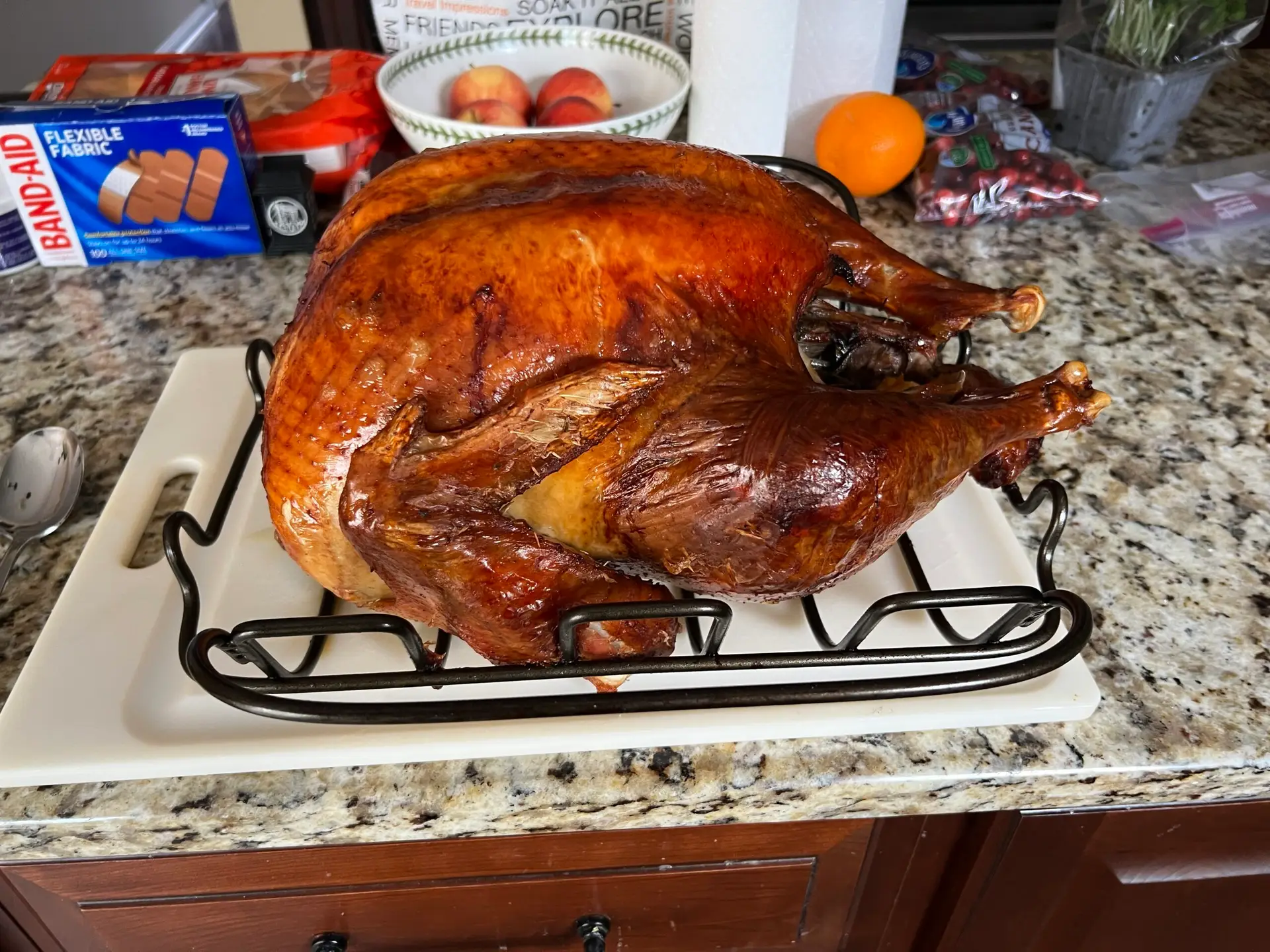
It was Black Friday 2021, the day after Thanksgiving, when I decided to hit Wegmans. Not in search of turkey, in search of beef. The COVID restrictions we’d lived with for the better part of 18 months were easing, and people could once again shop the Black Friday bargains in person. While most shoppers hit the malls, I was at Wegmans, hunting for a bargain prime rib for Christmas.
In years past, the Wegmans butcher counter held a post-Thanksgiving sale on the unsold fresh, locally sourced prime rib roasts it had stocked up on for the holiday. The markdown was usually half price, and I loved to take advantage of it. I’d throw the roast in my freezer and pull it out a few days before Christmas for our family Christmas Eve dinner.
Not in 2021. COVID-driven supply chain shortages pushed Wegmans to switch from local farms to one of the biggest national meat packers in the country. Their beef now arrives pre-cut, vacuum sealed, and frozen solid. They thawed what they needed to meet the more limited Thanksgiving demand and kept the rest in the freezer, where it waited out Thanksgiving to be sold at a higher price, for the more beef-friendly Christmas and New Year’s feasts.
I struck out on the prime rib, but I found a display case full of “fresh” turkeys, as in freshly thawed from 26 degrees, marked down more than 50%, to 69 cents a pound. This was before bird flu and inflation sent turkey prices soaring, but even by 2021 standards that was a steal. The case was full of 20-pound fresh turkeys going for about $13.50 apiece. I had no idea what I was going to do with them. I just knew I couldn’t let the deal pass me by.
The sign on the case said “Limit 1 per customer,” but given how many turkeys were in it, I thought they might relax the rule. I asked a butcher roaming the meat department if I could take two. He gave me a sad, resigned look and said, “Mister, you can buy them all if you want. In fact, please do. We over-ordered this year, and whatever doesn’t sell by the end of the day gets tossed.” I should have bought them all, but I stopped at three, mostly because a fourth wouldn’t fit in my cart. I tried.
These were Wegmans Premium Holiday Grand Champion turkeys, the store brand, which I later learned meant they came from Jaindl Farms in Pennsylvania’s Lehigh Valley. I wrote about Jaindl in Part 1. Of all the broad breasted whites I’ve cooked, Jaindl’s are the most flavorful. Which is not to say they have much taste. They’re still broad breasted whites, bred for massive breasts and fast growth, and the trade-off for both was flavor.
As I drove home wondering what I was going to do with three 20-pound turkeys, an idea popped into my head. For several years I’d been buying our Thanksgiving turkey from a local hobby farm, to the tune of $75 for a 16-pound bird. Year after year, I was unimpressed. No matter what I did, I couldn’t get those fresh, local turkeys to cook up moist and flavorful. It made me wonder whether I was wasting my money. How would a $13.50 store-brand turkey stack up against the smaller, pricier $75 hobby farm bird? I decided to use my bargain turkeys to find out.
The first test would be a straight comparison of one “fresh” bird against another. With the hobby farm turkey from the previous day’s Thanksgiving dinner still fresh on my palate, I cooked up one of the Wegmans birds right away.
The rest of the test would settle whether a fresh turkey is worth paying more for than a frozen one. Fresh turkey can cost nearly double what you’d pay for frozen, and I wanted to know if the difference in flavor and moisture justified it. I tossed the other two turkeys in my sub-zero freezer, planning to cook one about three months later and the other about eight months later. Wegmans wasn’t allowed to do that. Once thawed, their turkeys had to be sold or tossed. I could, and I did.
The Setup
When I run a taste test, I like to control for as many variables as possible. This one was meant to find out whether a local hobby farm bird was worth three to four times the price per pound of a grocery store bird. Both turkeys were the same breed: broad breasted white, by far the most common turkey sold in this country. Both were “fresh, never frozen,” though the ice crystals on the hobby farm bird told me that was hogwash. Both were labeled hormone and antibiotic free. If you read Part 1, you know most of that was marketing, but at 69 cents a pound on sale, I wasn’t paying extra for it. Neither turkey was self-basting, and neither had been injected with moisturizers, fat, butter, MSG, or other flavorings. They were 100% turkey, plus the extra water they were stuffed with in the processing plant to keep them “fresh” until sold. That water does keep the turkey from drying out in shipping, but it does nothing for the flavor. And you are paying for that extra water since the turkey is weighed after the water is added. The one difference: the Wegmans turkey came with a pop-up timer and the hobby farm bird didn’t. I don’t use pop-up timers, so that didn’t matter.
To Brine or Not to Brine
I brined both turkeys with the same brine recipe (store-bought Bell’s Turkey Brine) for the same amount of time. The water added for shipping doesn’t work its way into the muscle tissue, the turkey just sits in it until you open the packaging and drain it. Or it cooks out when you roast the bird. I’ll get into brining in Part 3.
I don’t stuff my turkeys. My stuffing bakes in its own dish, which technically makes it dressing, but that too is another story. I do put aromatics in the cavity: for both birds a couple of sprigs each of fresh rosemary, sage, and thyme, a sliced apple, orange, and onion, and two cinnamon sticks. In theory, the steam that builds as the turkey roasts draws out the aromatics, flavoring the meat from the inside out. In practice, it helps only a little. Most of the flavor a brined turkey gets comes from the salt in the brine. The real reason I bother is that it makes my kitchen smell like Thanksgiving, and that makes me happy.
I didn’t bother with fancy trussing. I tucked the wings under both birds to keep them out of the way. The hobby farm turkey’s legs were loose, so I tied them together with butcher’s twine. The Wegmans bird came with an oven-safe silicone band holding the legs together, so I left it in place. I coated the skin of both birds with duck fat for browning and crispness, then sprinkled on rubbed sage and a blend of poultry spices I make up. It’s mostly dried sage, thyme, and rosemary, with some paprika and garlic powder.
Feel the Heat
I used the same roasting pan for both birds, with a rack to keep them up out of the drippings. I didn’t baste. Brined turkeys don’t need it. I preheated the oven to 450°F and roasted each bird at that temperature for 30 minutes to crisp the skin, then turned it down to 325°F until done.
The 16-pound hobby farm turkey was ready after 2 hours and 30 minutes. The 20-pound Wegmans bird took 3 hours and 25 minutes. For both, I used an oven-safe probe thermometer in the deepest part of the thigh, with the alarm set to 160°F. When it went off, I spot-checked the breast and thighs with an instant-read thermometer, and once everything read 160°F or above, the turkey came out. You can safely pull it as low as 155°F. The temperature continues to rise while the bird rests. Both birds rested for 30 minutes, and their temperatures kept climbing. By carving time, the lowest reading was 165°F and some spots hit 185°F, a good range for safety and moistness.
And the Winner Is…
The hobby farm turkey was just OK. The $13.50 Wegmans store-brand turkey was better. By a lot. It was more moist and had noticeably more turkey flavor. Which is not to say it had a lot of flavor, but it had more than the hobby farm bird, which had none. Where I really noticed the difference was in the leftovers. The Wegmans leftovers stayed moister and more flavorful than the hobby farm bird, and that matters to me, because the best part of Thanksgiving dinner is the leftovers.
Round Two: Fresh vs. Frozen
Round two was fresh versus frozen. I had cooked the first Wegmans turkey the day after I bought it and put the other two straight into my sub-zero freezer in the packaging they came in from the store. Extra water and all.
I cooked one in February, about three months later, and the other in July, about eight months later, both using the same method as the first. The turkey that spent three months in the freezer tasted exactly like the fresh bird and was just as moist. At eight months, I noticed a slight drop in moisture and flavor, but only slight. I would happily serve either one for Thanksgiving rather than pay extra for a “fresh, never frozen” turkey.
The Myth of “Fresh, Never Frozen”
When I run a taste test, I research the heck out of every part of it. That’s how I learned so much about the broad breasted white for Part 1 of this series. For fresh versus frozen, I dug into how the USDA defines each one, and how both kinds of turkey get from the farm to the store.
Here’s what I learned. The USDA lets a turkey be sold as “fresh” as long as it has never been chilled below 26°F. “Frozen” means 0°F or below. Turkey meat freezes at around 28°F, so a “fresh” turkey can spend its trip to the store chilled hard enough to be stiff to the touch. To me that’s frozen. I don’t know about you, but that’s not what I picture when I read “fresh, never frozen.”
I’m OK with that. It can take a couple of weeks to get a turkey from the processing plant to your table, and as much bacteria as turkeys carry, keeping them frozen is the safest way to handle them. I’d just prefer the label say “thawed for your convenience.” My taste test showed that with modern processing and packaging, there is no difference in quality between a fresh turkey and one that spent three months in my sub-zero freezer.
When my father served in the Army and my mother bought our Thanksgiving turkey at the commissary, those birds had probably been in a freezer for a year, maybe several. Frozen turkeys today may still have been processed months before you buy them. But my test says a few months in the freezer doesn’t hurt them, and commercial freezers do a better job than mine.
The Bottom Line
It really doesn’t matter whether you buy a national brand like Butterball or Jennie-O or a generic store-brand bird. They’re all broad breasted whites, which means they have little taste. And to get the deepest part of those massive breasts to a USDA-safe 165°F, you have to overcook the rest of the bird, which leaves it dry as well as tasteless. Buying from a local farm may have its advantages, but do your homework to make sure a bird that costs three or four times as much per pound is worth it. My hobby farm birds weren’t.
For my money, if I can get a Jaindl Farms turkey, I’ll pay extra. Even after switching to national packers for much of its meat after COVID, Wegmans still sells Jaindl turkeys as Wegmans Premium Holiday Grand Champion. They come from the same farm that supplies the White House Thanksgiving dinner, and that’s good enough for me.
In Part 3, the last in this series, I’ll cover what you can do to make a broad breasted white turkey moist and flavorful, in spite of its genetic predisposition to the contrary.